A robot dog for sniffing out hazardous gases
Marie Donlon | June 30, 2024Researchers from China’s Jinan University have outfitted a quadruped robot dog with a mechanized arm capable of taking air samples from potentially hazardous environments — for instance, from an abandoned building or fire.
To prevent humans from being exposed to potentially harmful environments, the quadruped robot has been designed to test the air for dangerous chemicals in areas affected by fire or other incidents.
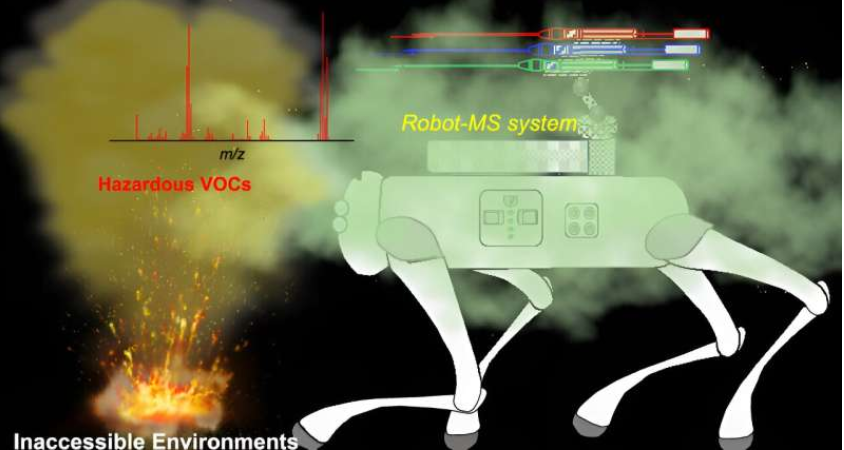 Source: Adapted from Analytical Chemistry 2024, DOI: 10.1021/acs.analchem.4c01555
To accomplish this, the team is working to develop mobile detection systems for hazardous gases and volatile organic compounds (VOCs) by constructing remote-controlled sampling devices, including the robotic dog.
The dog-like robot features an articulated testing arm mounted on its back that is loaded with three needle trap devices (NTDs) capable of collecting air samples.
The researchers trialed the four-legged robot in an assortment of inaccessible environments — a garbage disposal plant, a sewer system, a gasoline fireground and a chemical warehouse — where it sampled the air for hazardous VOCs. The team reported that although it struggled to navigate rainy and snowy weather, the robot successfully collected air samples and subsequently returned them to the portable mass spectrometer (MS) for onsite analysis in less time than it would take to transfer the samples to an off-site laboratory, proving itself, the researchers suggested, as a safer approach for detecting potentially harmful compounds.
The study “Portable Mass Spectrometry for On-site Detection of Hazardous Volatile Organic Compounds via Robotic Extractive Sampling,” appears in the journal Analytical Chemistry.