KRISS team creates early detection system for preventing damage to buried pipelines
Marie Donlon | March 10, 2024A damage prevention and early detection system for preventing buried pipeline failures caused by third-party interference (TPI) as well as other threats has been created by a team of researchers from the Korea Research Institute of Standards and Science (KRISS).
Considered one of the primary causes of damage to buried pipelines used in the transport of water, petroleum, gas and other substances, TPI leaks in damaged pipelines can reportedly lead to environmental contamination as well as explosions, fires and sinkholes. Yet, despite its many threats, TPI is difficult for pipeline management entities to detect in advance.
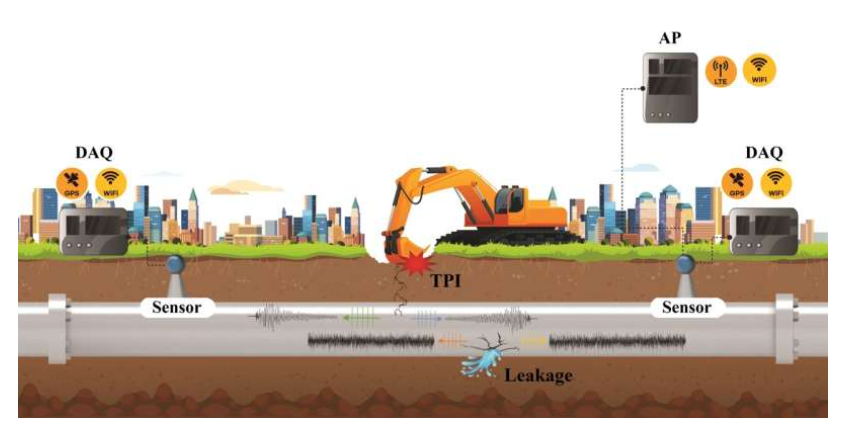 Scenario for damage prevention and early detection system for buried pipelines. Source: KRISS
Consequently, the KRISS team created a real-time monitoring system that is capable of identifying activities that occur ahead of buried pipelines sustaining damage. For instance, when threats like TPI occur in the area surrounding pipelines, the system will reportedly recognize the risk and offer early warnings to prevent an incident.
To accomplish this, the system relies on the accurate measurement and analytical models of the elastic wave propagated upon impact to the pipelines. The researchers explain that a pair of sensors is placed several hundred meters apart along the pipeline so that the system can perform real-time monitoring of the impact signals occurring between those sensors.
The system is reportedly similar to seismological centers — which detect vibrations and localize the source position of an earthquake via the arrival time of seismic waves — offering the instant calculation of both the time and location of the impact.
According to the researchers, the sensors can be attached to exposed parts of the buried pipelines — the valve chambers or manholes, for instance. Additionally, the system uses analytical algorithms for limiting and filtering out signals like noise from the surrounding environment such as traffic.
During testing, the researchers reported that the system detected impacts over roughly 20 kN — significantly less than the several hundred kN range of force that typically causes pipeline damage — with a rate of accuracy more than 95%.
The KRISS team is eyeing the system for potential use on water, oil and gas, and heat supply pipelines, among others,
The system is detailed in the article, ”Source location and anomaly detection for damage identification of buried pipelines using kurtosis-based transfer function, “ which appears in the journal Structural Health Monitoring.