Upcycled fish scales show promise for security and pollution control applications
Marie Donlon | March 20, 2024National University of Singapore (NUS) physicists have developed an approach for converting fish scale waste into a material for encrypting sensitive information or functioning as a bio-adsorbent for removing Rhodamine B pollutant.
In a bid to reuse this abundant waste material, the NUS team determined that fish scale waste, when subjected to appropriate heating conditions, undergoes a transformation — changing its color from royal blue to cyan under ultraviolet (UV) light. This change occurs whether a hotplate or a focused laser beam was used in the lab.
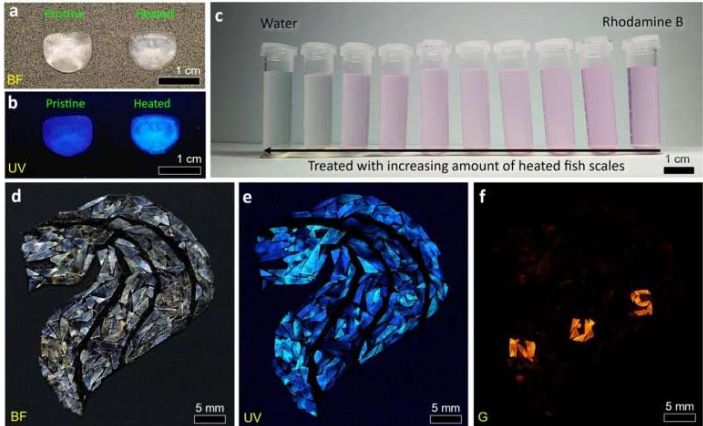 Figure shows heated fish scale wastes as chemical biosorbent and an alternative form of security material for text and image transmission. Source: Sow Chorng Haur
Further, the researchers discovered that treated fish scales could function as adsorbents for Rhodamine B, which is a potentially hazardous dye that threatens both human health and marine ecosystems. In the lab, the treated fish scales reportedly removed 91% of Rhodamine B within 10 minutes of contact. The team envisions using the treated fish scales in future Rhodamine B test kits for use in outfield detection.
Also in the lab, the researchers discovered that they could tune the fluorescence of the material, thereby allowing text and images to be engraved onto the fish scale surface without obvious changes. This reportedly demonstrated the material’s potential for use in multidimensional security applications wherein micro- and macroscopic text and imagery might be transmitted.
An article detailing the findings, “Upcycling fish scales through heating for steganography and Rhodamine B adsorption application,” appears in the journal Nature Communications.