Limescale-repellent coating developed by ETH Zurich
Marie Donlon | March 05, 2024Researchers from ETH Zurich and the University of California, Berkeley have developed a limescale-repellent coating featuring microscopically small ridges that prevent the adhesion of limescale crystals.
Limescale is a scourge to domestic appliances and thermal power stations alike. Specifically, heat exchangers are particularly prone to limescale buildup, which dramatically reduces the efficiency of such systems. According to the researchers, a layer of limescale just 1 mm thick accumulating on a heat exchanger's pipes will reduce the efficiency of electricity production by roughly 1.5%. Consequently, compensating for such losses would require the burning of an additional 8.7 million metric tons of hard coal — which is both expensive and damaging to the environment.
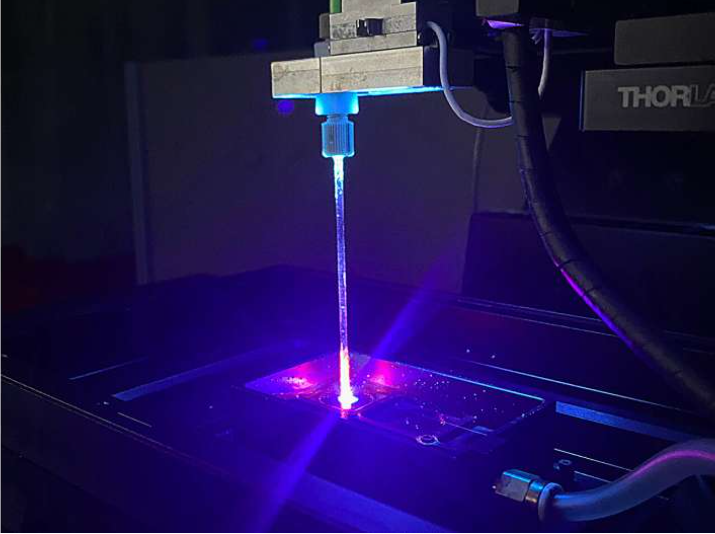 Test set-up with which the researchers tested how lime crystals adhere to different surfaces. Source: Julian Schmid/ETH Zurich
To develop the limescale-repellent coating, researchers first looked at the interactions among individual growing limescale crystals, surrounding water flow and the surface at the microscopic level.
In the lab, the researchers determined that the most effective limescale-repellent coating was composed of a polymer hydrogel that featured a surface covered in tiny ridges developed using microtextured molds fabricated by the researchers via photolithography.
When applied to kettles or boilers, the ridges on the hydrogel surface ensured that the limescale crystals had less contact with the surface so that they could not adhere and were subsequently easier to remove. Meanwhile, water flowing over the hydrogel and through the ridges carries the crystals away. The team explained that although the coating cannot prevent limescale crystals from forming entirely, the constant passive removal of the microscopic crystals prevents them from growing together to form a layer.
As they worked to produce the coating, the team discovered that the lower the polymer content and the higher the water content, the less likely the crystals could adhere to the surface.
The team further determined via a series of lab tests that model particles composed of polystyrene showed that the coating's surface structures need to be smaller than the particles deposited on it, so as to reduce the contact surface and, subsequently, the adhesive force.
The researchers suggest the coating is eco-friendlier than most descaling solutions that rely on toxic and aggressive chemicals.
An article detailing the coating, “Imparting scalephobicity with rational microtexturing of soft materials,” appears in the journal Science Advances.