
Researchers develop a smart wound soldering paste
Marie Donlon | February 05, 2024A team of researchers from the research institute Empa and ETH Zurich has developed a smart wound soldering paste for closing wounds without sutures and staples.
The smart wound soldering paste, dubbed iSolder, which stands for intelligent solder, has been developed for wound sealing applications where sutures and staples would pose a challenge — particularly in the case of soft tissues where a needle and thread might cause more damage.
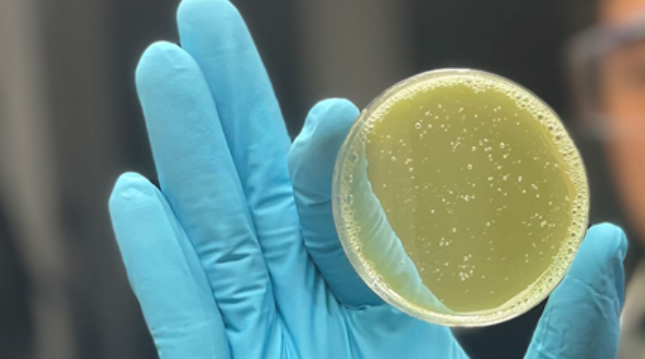 Ceramic nanoparticles act as tiny thermometers in the "iSolder" paste for soldering wounds. Source: Empa
According to the researchers, in such a case, tissue soldering would be used, wherein a gelatinous paste — in this case, iSolder — is applied to delicate wound tissue or in hard-to-reach areas, and a laser is used to apply heat to the treated area to fuse the tissues and seal the wound.
This laser soldering approach promises to “prevent wound healing disorders and life-threatening complications from leaking sutures,” explained the researchers.
To create the paste, a bonding agent that contains metallic and ceramic nanoparticles was used. The temperature of laser soldering is regulated in real time via nanothermometry, which measures and monitors temperatures at the nanoscale.
“While the paste is irradiated by laser, titanium nitride nanoparticles convert the light into heat. The specially synthesized bismuth vanadate particles in the paste, on the other hand, act as tiny fluorescent nano thermometers,” explained the researchers.
Once developed, the team tested the overall performance of the composite paste, finding that they were able to accomplish "fast, stable, and biocompatible bonding of wounds" in assorted tissue samples. Further, effective sealing was also achieved in so-called complicated regions of tissue, including the urethra, fallopian tubes and intestines.
The team, in subsequent trials, eventually swapped out the laser light source with a milder infrared (IR) light, which promises to bring this soldering approach closer to practical use in hospitals.
The soldering paste is detailed in the article, “Nanothermometry-Enabled Intelligent Laser Tissue Soldering,” which appears in the journal Small Methods.
Soldering of the skin. Intriguing . . .