The solar potential to power smart devices indoors
S. Himmelstein | January 08, 2024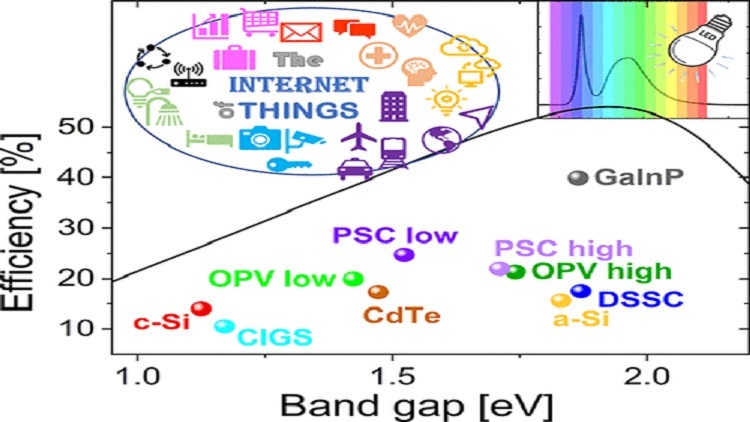 Eight different PV technologies were tested under identical indoor illumination conditions. Source: ACS Appl. Energy Mater. 2023, 6, 20, 10404–10414
The expanding capacity to control wearable devices, appliances and other smart electronic systems via internet of things (IoT) technology also increases the need for secure electricity sources to power these components. In search of an alternative to grid connections and batteries to drive the IoT, an international team of researchers examined prospects for bringing photovoltaics (PV) into the indoor environment.
While available PV panels are not engineered to harness indoor light, organic films and other advanced materials are emerging as promising options for deployment in building interiors. To gauge which solar energy conversion systems are best suited for such applications, eight different PV technologies were tested under identical indoor illumination conditions. These included devices based on amorphous and crystalline silicon, copper indium gallium selenide, cadmium telluride, III–V, organic, dye-sensitized and perovskite materials.
As reported in ACS Applied Energy Materials, cells composed of gallium indium phosphide demonstrated the greatest efficiency under indoor light, converting 39.9% of the white LED light energy into electricity. Crystalline silicon posted the best efficiency under sunlight but was average under indoor light.
Despite its high conversion efficiency in the indoor environment, the high cost of gallium-containing materials may preclude its use in powering smart home systems. Lower cost perovskite mineral and organic film PV cells perform without stability issues under indoor lighting conditions and may prove to be the future power source behind IoT systems.
Researchers from Fraunhofer Institute for Solar Energy Systems ISE (Germany), University of Freiburg (Germany), Zentrum für Sonnenenergie-und Wasserstofforschung Baden-Württemberg (Germany), Swansea University (Wales), Saule Technologies (Poland) and Newcastle University (U.K.) contributed to this study.