A solar solution for powering IoT sensors
S. Himmelstein | September 30, 2019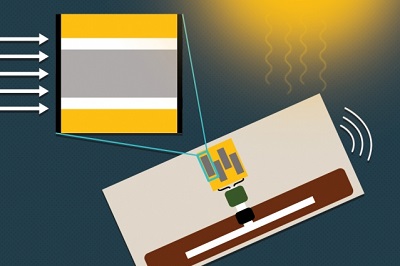 Photovoltaic-powered sensors on RFID tags work in sunlight and dimmer indoor lighting, and can transmit data for years before needing replacement. Source: MITA reliable power supply for sensors connected to the internet of things (IoT) would eliminate the need for frequent battery replacement and ensure continuous data collection. A solution in the form of thin-film perovskite solar cells combined with radio frequency identification (RFID) tags has been engineered by MIT researchers as on-board power sources for low-power IoT devices.
The solar cells serve as energy harvesters in both outdoor and indoor conditions to power multiple sensors integrated on a single RFID tag. A wireless reader sweeps the room and each tag responds, drawing harvested energy from the solar cell to power up its circuit and transmit data by backscattering RF signals.
A wireless temperature sensor powered by a perovskite indoor light-harvesting module was demonstrated with efficiencies of 18% to 21% under fluorescent lighting. Under one sun illumination, a 10% efficient perovskite device generated an output voltage of 4.3 V, sufficient to transmit data 5 m every few seconds.
The perovskite photovoltaic-powered RFID technology can be integrated into environmental sensors for the long-term wireless monitoring of pollutants, humidity and other parameters of interest.