“Super Pump” Battles Large Rocks
By Engineering360 News Desk | February 10, 2016Equipped with an 84-in.-diameter impeller, the so-called “super pump” installed two years ago at the Aurora Mine, 75 miles north of Fort McMurray, Canada, has avoided costly pump outages that plagued the mine from its inception in 2000. And, with fewer outages, maintenance costs have been cut by $3 million/year.
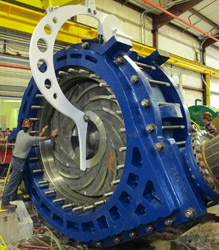 The impeller’s increased size allows it to rotate 35% slower than before.The key to this performance is the slurry pump’s 50% larger impeller compared to the mine’s original pumps, and the impeller’s increased bulk—it weighs three times what the original pump impeller weighed.
Dan Wolfe, who designed the pump for mine operator Syncrude, says, “In Aurora’s first 10 years of operation, there were outages in one system or another on a weekly basis. We didn’t fully understand why we were having so many maintenance issues, relative to the North Mine.”
Wolfe and his team learned that the area of the Athabasca Oilsands contains rocks twice the size of the rocks at Syncrude’s other mine in the area, the Mildred Lake Mine. Moving the oil sand slurry—more than 3 billion t-km per year—through 30-in. pipelines taxed the undersized pumps. The mine experienced three major pump outages per year, and a mean time between maintenance (MTBM) of 1,000 hours.
Wolfe and his team then set out to design a pump that would run for 6,000 hours MTBM. It also established the goal of having one major outage per year to alleviate the reliability bottleneck that had formed.
The increased size of the impeller allows it to rotate 35% slower than before, while maintaining the same level of output pressure and flow. Lowering the speed helps to create less impact from the large rocks and clumps of oil sand, resulting in less maintenance. Impact velocity dropped from 16 m/sec. to 10 m/sec.
Wolfe says that going from three major pump outages to one in a year is a “huge accomplishment.”