A robot for the electrochemistry lab
S. Himmelstein | December 01, 2023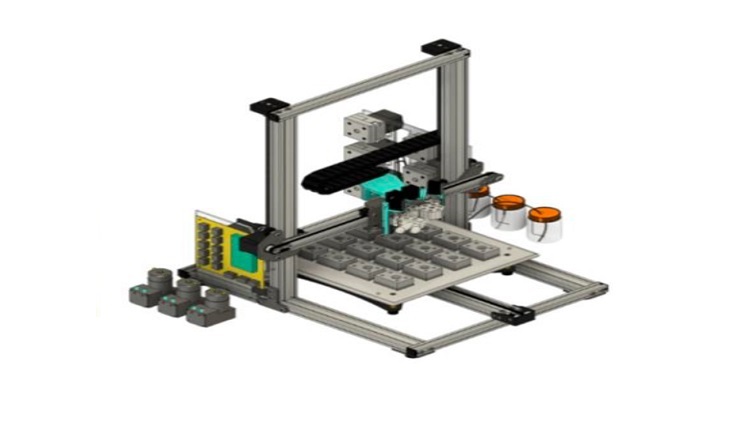 Diagram of the Electrolab. Source: Device (2023). DOI: 10.1016/j.device.2023.100103
Robots are being put to work in manufacturing facilities, transportation hubs and now the laboratory. A benchtop robot has been developed by researchers from the University of Illinois at Urbana-Champaign and the Joint Center for Energy Storage Research to conduct complex electrochemical experiments and analyze data.
Electrolab characterizes redox-active electrolytes with the aid of Python software and microfabricated electrodes, performing its mission with minimal human oversight. The solution-handling robot is intended to reduce the time and effort required for electrochemical investigations by automating many basic and repetitive laboratory tasks.
The open-source software allows for fully automated data analysis, visual graphics and plotting. Machine learning empowers the Electrolab to transform from a robot completing predetermined tasks to a system that can make decisions and direct the progress of an experiment. A standard 3D printer frame was redesigned to allow the robot to move within a designated area above electrochemical cells to dispense different liquids.
Electrolab performed 200 voltammograms and data analysis steps across a range of conditions for the autonomous analysis of a redox mediator. This task was completed in two hours, a far shorter timeframe than the eight hours typically needed by human workers. The automaton was also put in charge of titrating a redox-active polymer solution to identify conditions for optimizing electrochemical performance.
The researchers provide instructions in the journal Device for converting a 3D printer into the solution-handling robot.