Study: Drones could speed AED delivery to cardiac arrest scenes
Marie Donlon | November 15, 2023A team of researchers from the University of Toronto and Duke University, among others, is suggesting that a drone delivery system could improve patient access to automated external defibrillators (AEDs), which are used to shock the heart rhythm back to normal when a person is experiencing cardiac arrest.
The researchers determined that access to AEDs for those experiencing out-of-hospital cardiac arrest could potentially double or triple a person's rate of survival. Yet, access to AEDs, particularly in rural settings, is limited. As such, the team created a simulation model that estimated how fast an AED could be delivered to the scene of a cardiac arrest event in 19 counties located throughout North Carolina.
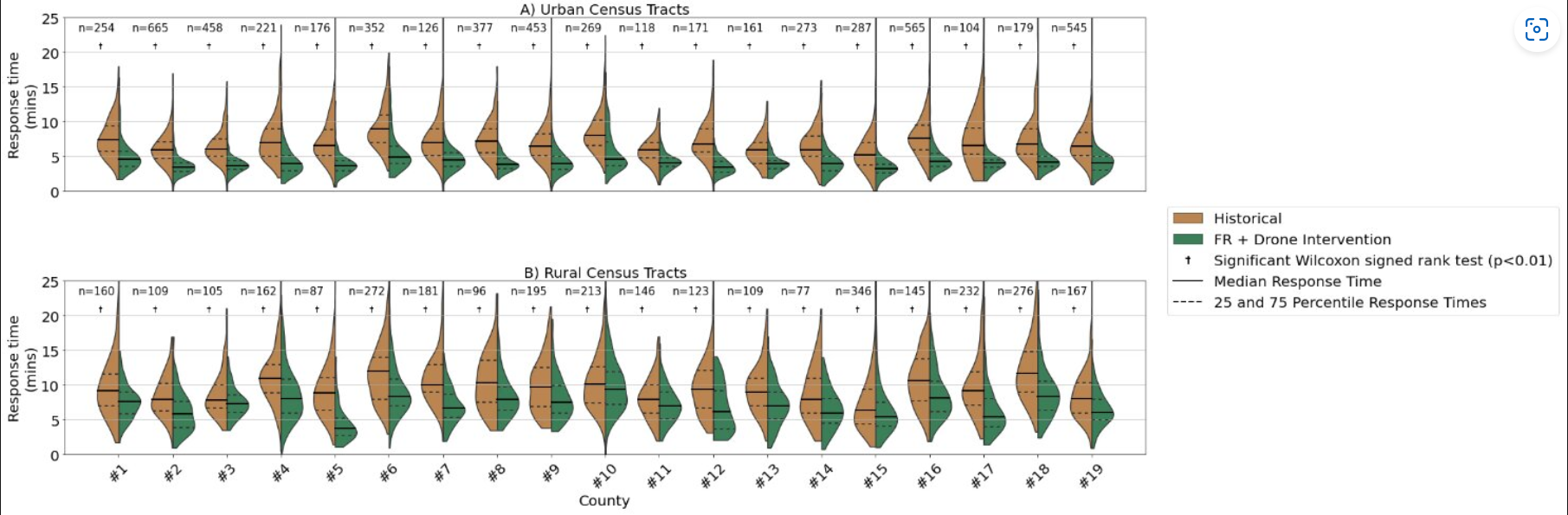 Source: Jamal Chu et al, Rural-Urban Differences for Integrated First Responder and Drone Automated External Defibrillator Delivery in North Carolina.
The simulation model, hypothesizing that all local first responders carry an AED, subsequently optimized a network of AED-carrying drones and compared the response time of a hypothetical drone network and historical data from local first responder response times.
According to the researchers, the model revealed that a network of AED-carrying drones would improve response times and thus survival rates of those experiencing cardiac arrect in both rural and urban areas.
Surprisingly, the team determined that the five minute response time for AED arrival would improve 24% to 77% for urban areas and 10% to 23% for rural areas, while estimated average response times would potentially be reduced by 42% to 4 minutes in urban areas and by 24% to just over 7 minutes in rural areas.
"We were a bit surprised that the improvements appeared greater in the urban areas. There's an historical inequity in EMS response times in rural versus urban areas, so we anticipated that drones could provide a bigger improvement in response times in rural areas and, thus, reduce that inequity," the researchers explained.
The research will be presented at the American Heart Association's Resuscitation Science Symposium 2023, which will be held Nov. 11–12, in Philadelphia, Pennsylvania.