Trains that fly: How magnetic levitation works
Jody Dascalu | October 11, 2023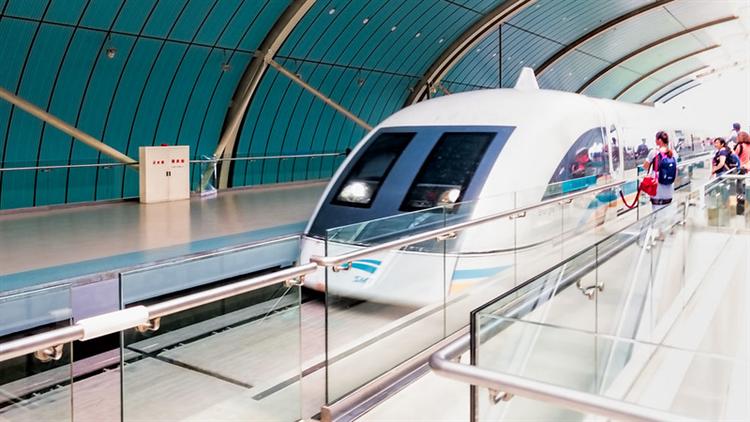 Source: Dan Lundberg via Flickr/CC BY-SA 2.0
High-speed rail systems have become an integral part of global transportation, offering efficient and fast travel options. One key advancement in this domain is magnetic levitation, or Maglev. Unlike traditional rail systems, Maglev trains operate without direct contact with tracks, leveraging magnetism to reduce friction and achieve higher speeds.
Currently, several countries are integrating high-speed rail networks into their transportation infrastructure. Examples include Japan's Shinkansen and Europe's TGV lines. These networks serve as vital transport links, facilitating economic growth and enhancing regional connectivity.
Brief history of high-speed rail systems
Railways had their beginnings in the 1550s with Germany's wooden "wagonways." By the late 1700s, iron supplanted wood, bringing about Europe's "tramways." The steam-powered locomotive's advent in the early 19th century in Great Britain marked a pivotal turn, with trains first serving coal routes before transitioning to passenger transport. In the U.S., the period from the 1880s to the 1920s epitomized the "Golden Age" of railroads. However, the 20th century saw steams decline as electric and diesel locomotives rose to prominence in Europe, paving the way for modern high-speed rail.
High-speed rail began with Japan's Shinkansen in 1964, a precursor to Europe's developments like Italy's 1977 Rome-Florence line and France's 1981 Paris-Lyon service. Korea's Seoul-Pusan was operational by 2010. The 21st century marked China's ascent, from no high-speed lines to a 38,000 km network, targeting 70,000 km by 2035. The U.S. has the Acela line with advancements stymied by challenges, though the 2021 Infrastructure Act promises $66 billion for rail. Notably, Switzerland introduced the Gotthard Base Tunnel in 2016, a significant global rail milestone.
Today, high-speed rail underscores continuous engineering advancements in transportation. As global needs shift toward efficient connectivity, the focus will be on further refining rail technologies to enhance speed, reliability and cost-effectiveness.
Principles and technologies
The underpinning of high-speed rail systems is track design. Choices are chiefly between ballasted tracks, utilizing a bed of crushed stone for load distribution and drainage, and slab tracks, which employ a concrete foundation for enhanced stability, especially in high-speed operations or limited space scenarios.
Aerodynamics is a significant concern, particularly the "tunnel boom" resulting from rapid air compression and decompression when trains move between tunnels. This is managed through specific train nose designs and optimized tunnel entrances. The incorporation of lightweight materials such as aluminum ensures speed and weight efficiency. Coupled with innovations in wheel design and modern suspension systems, this ensures maximum rail contact, reduces wear and noise, and enhances passenger comfort.
Traditional high-speed rail systems predominantly rely on steel wheels on steel rails. The older turbo trains, previously prevalent in North America and powered by gas-turbine engines, have now been succeeded by electric variants, exemplified by Japan’s Shinkansen. These draw power from overhead wire systems and boast specialized safety features, like advanced braking systems. A centralized computerized facility rigorously monitors train movements and track conditions for maximum safety.
A breakthrough in high-speed transit was the magnetic levitation (Maglev) system. Unlike conventional trains, Maglevs employ electromagnetic force for levitation. There are two prominent Maglev types: Electromagnetic suspension (EMS) and Electrodynamic suspension (EDS).
EMS, and its variation Transrapid, rely on the attractive force between train magnets and those on the guideway to maintain a levitation of about 1.3 cm above the guideway. In contrast, EDS utilizes supercooled, superconducting magnets that repel the train from the guideway, resulting in a levitation typically between 1 cm and 10 cm. EDS trains initially utilize wheels below speeds of 100 km/h but transition to levitation at higher speeds, propelled forward by alternating guideway coil polarity.
The ascent of maglev and high-speed rail
High-speed rail and Maglev projects are not only revolutionizing modern transportation but are also under continuous research and development. The primary advantage of Maglevs is the elimination of wheel-rail friction, allowing for higher speeds, though they still face challenges such as air resistance. Presently, some Maglevs can achieve speeds over 500 km/h, rivaling France's TGV. They are characterized by their reduced maintenance costs due to the absence of rolling friction, yet air resistance means they do not necessarily outpace conventional trains in energy efficiency. They offer other benefits like reduced noise, a smoother ride and the ability to handle steeper grades.
A testament to the advancement of Maglev technology is China's showcase of a Maglev capable of reaching 600 km/h, marking a significant milestone. Moreover, Japan and South Korea have established operational Maglev routes. Japan, in its ambitious pursuit of rail technology, plans the Chuo Shinkansen, a long-distance high-speed maglev system that aims to connect Nagoya to Tokyo by 2027, covering a distance of 286 km. With an extension to Osaka planned for 2037, the system is designed to reach speeds of 500 km/h, making the Tokyo-Osaka journey in just 67 minutes.
Research consistently emphasizes the significance of levitation control algorithms in Maglev trains. Historically categorized by accuracy, complexity and intelligence into linear, nonlinear and intelligent control methods, each method has its distinct strengths and optimal application scenarios. For static levitation scenarios, linear feedback controllers are adequate, but external disturbances or vehicle-rail vibrations necessitate robust and adaptive nonlinear control methods. For advanced safety, adaptability, and self-diagnosis, intelligent control algorithms are progressively preferred.
Emerging research in Electromagnetic Suspension (EMS) levitation control emphasizes merging traditional state feedback with nonlinear and intelligent control. The focus should be on enhancing nonlinear control adaptability and boosting intelligent algorithm efficiency. A shift from decentralized levitation control strategies to holistic models, integrating multi-electromagnet systems, network transmission and fault diagnosis is crucial. Bridging the gap between theoretical research and practical implementation requires that these innovative control methods undergo rigorous testing on actual vehicles and testbeds. This amalgamation of research and real-world trials will push high-speed rail and Maglev systems into a new age of efficiency, safety and reliability.
The future of high-speed rail and Maglev
Anticipation surrounds the future advancements in high-speed rail and Maglev technology. One promising area of research is the development of room-temperature superconductors, which, if realized, could drastically improve the efficiency and cost-effectiveness of Maglev systems. Automation, integrating AI and advanced sensors, will likely play a pivotal role in train operations, enhancing safety and optimizing schedules.
From a geopolitical perspective, countries are acknowledging the economic benefits of high-speed networks, leading to international collaborations for rail projects. Routes connecting regions and even continents, such as the proposed Beijing to London line, are under discussion. However, challenges remain. The immense capital required, concerns over land acquisition and technological hurdles can impede expansion. Nevertheless, the opportunities — reduced travel times, economic growth and sustainable transport — make the pursuit of these advanced rail systems a global priority.
About the author
Jody Dascalu is a freelance writer in the technology and engineering niche. She studied in Canada and earned a Bachelor of Engineering. As an avid reader, she enjoys researching upcoming technologies and is an expert on a variety of topics.