These materials will soak up oil spills: Part 1
Marie Donlon | October 30, 2023Oil spills are hazardous environmental disasters that occur when somewhere along the production line there are failures, be it damage to pipelines, tankers, barges, refineries, drilling rigs or storage facilities.
In the event that any of these sustains damage, liquid petroleum hydrocarbons are released into the environment. Because the chemical constituents of oil are poisonous, they can prove deadly to organisms both on land and in bodies of water. Likewise, oil spills can threaten habitats and erode shorelines.
As such, a number of efforts have been devised to quickly clean up oil if an oil spill, both on the magnitude of the Deepwater Horizon spill in the Gulf of Mexico or as small as that spilled from a recreational boat, occurs.

Follow along with GlobalSpec as we examine, in a two-part feature, some of the technologies being used to clean up oil spills, ranging from sponges to even human hair. Part one will focus exclusively on the number of sponge material solutions currently in development for cleaning up oil spills.
Sponges
Nanoparticle-enhanced sponge
Researchers from the University of Toronto and Imperial College London have developed a surface-engineered sponge that more effectively removes oil microdroplets over a range of pH conditions.
Researchers added nanocrystalline silicon particles to the sponge material, thereby improving the surface chemistry and area of polyurethane foam for oil retention. While the foam material absent the silicon nanoparticles captured about 95% of oil in water during lab tests in three hours, the chemically modified sponge took just 10 minutes to remove 90% of the oil.
Oleophilic sponge
Researchers from Northwestern University have developed an oleophilic, hydrophobic and magnetic sponge that can selectively absorb more than 30 times its weight. This, according to researchers, is due to the application of a nanocomposite coating and use of a magnetic, water-repelling and oil-attracting carbon-based substrate.
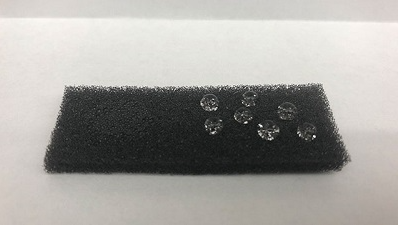 Source: Northwestern University
Making this approach environmentally safe is that the new sponge does not introduce additional agents into the ecosystem. This is because its nano-porous 3D structure selectively interacts with and binds to oil molecules. Once captured, the oil is stored in the reusable material until it is squeezed out.
Coated sponge
A team of scientists from Imperial College London and the University of Toronto has created a sponge that is capable of cleaning up oil spills in Arctic waters with temperatures as low as 5° C.
This solution uses previously developed sponge technology in combination with a coating developed by the team of scientists that enables the sponge to recover oil droplets from waters with temperatures below 38° C — a temperature at which oil crystallizes and becomes viscous at its edges.
According to its developers, the paraffin-like coating features a chemical structure similar to oil, thereby creating a mutual attraction between the coating surface and the oil surface. Through a process called wax-wetting, wherein one fluid is used to displace another, the sponge is rinsed with a non-toxic solvent called heptol, which displaces the oil droplets. According to the scientists, both the sponge and the oil droplets can be reused.
In the lab, the coated sponge reportedly absorbed oil droplets from water in the temperature range of 5° C to 40° C, removing 90% to 99% of contaminants in under three hours.
Polyurethane sponge
Scientists from Russia’s Tomsk Polytechnic University and France’s University of Lille have developed a material that can purify water from oil products.
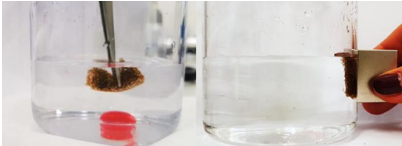 Source: Tomsk Polytechnic University
To develop a material that simultaneously repels water while sorbing oil product molecules, the scientists turned an ordinary household polyurethane sponge into a superhydrophobic material by adding diazonium salts to its structure.
To do this, the sponge was held in an aqueous solution with the diazonium salts and the mixture was heated to 60° C. This encouraged radicals to attack the sponge and produce new organic groups with hydrophobic properties to form on the sponge’s surface. Additionally, the sponge became sensitive to oil products, behaving as sorbents that selectively absorb oil molecules. Iron nanoparticles were also added to the sponge’s internal structure to aid in the removal of the material from the water.
Check back with GlobalSpec in the coming days for part two of this feature, which will cover material solutions for cleaning up oil spills, ranging from worms to dog fur.