A Northwestern sensor detects organ transplant rejection faster
Marie Donlon | September 30, 2023Researchers at Northwestern University have developed a thin medical sensor that can reportedly detect organ failure.
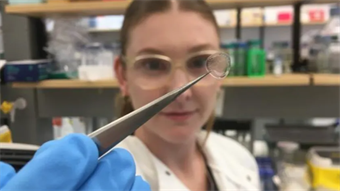
The ultra-thin, 0.3 cm wide, 0.7 cm long and 220 microns thick sensor — which is reportedly thinner than a human hair — has been designed to adhere to the surface of a transplanted organ and features an extremely sensitive thermometer.
 Source: Northwestern University
Adhered to an organ like a transplanted kidney, the medical sensor measures temperature fluctuation as minute as 0.004° C. Such fluctuations reportedly point to the beginnings of organ transplant rejection, according to the Northwestern University team.
By detecting such signals early on, organ transplant rejection can be detected up to the three weeks earlier with the sensor as demonstrated in animal trials conducted in Northwestern labs.
Such early detection could reportedly save the viability of the organ and subsequently, the life of the patient.
An article detailing the sensor, “Implantable bioelectronic systems for early detection of kidney transplant rejection,” appears in the journal Science.
For more on the ultrathin sensor, watch the accompanying video, which appears courtesy of Northwestern University.