Watch engineered living material tackle water pollutants
S. Himmelstein | November 08, 2023An engineered living material with relevance for bioremediation applications has been developed by University of California San Diego researchers.
The 3D-printed structure is composed of a seaweed-based polymer combined with bacteria that were genetically engineered to produce an enzyme that transforms various organic pollutants into benign molecules. The bacteria were also designed to self-destruct in the presence of theophylline, offering a way to eliminate them after their use as a sustainable solution to clean pollutants from water.
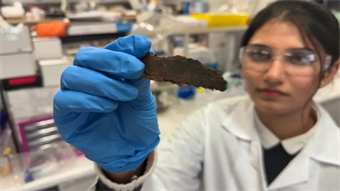
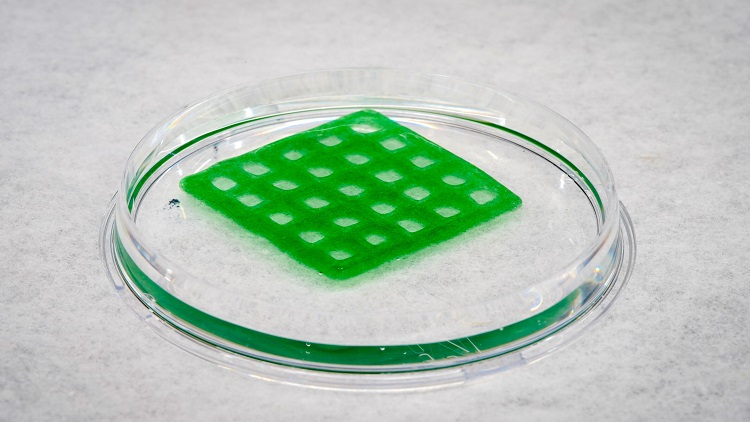 Formed with a natural polymer combined with genetically engineered bacteria, the living material could offer a sustainable solution to clean pollutants from water. Source: David Baillot/University of California San Diego
The water treatment material is based on the use of hydrated alginate to form a gel, which is then mixed with cyanobacteria and fed to a 3D printer. Tests demonstrated that a grid-like structure was optimal for keeping the bacteria viable. The selected shape has a high surface area to volume ratio, which places most of the cyanobacteria near the material’s surface to access nutrients, gases and light, all of which serve to enhance decontamination capacity.
As a proof-of-concept experiment, cyanobacteria were initially engineered to continually produce laccase, a decontaminating enzyme known to neutralize bisphenol A, antibiotics, dyes and other organic pollutants. Research reported in Nature Communications confirms that the material effectively decolorizes and treats the dye-based pollutant indigo carmine, a blue dye widely used in the textile industry to color denim.
Future improvements in enzymatic activity per unit volume of hydrogel expand applications to include bioremediation in lakes or water treatment plants.