A bio-based glue that strengthens its adhesive bonds underwater
Marie Donlon | September 15, 2023Researchers at Purdue University have developed a patent-pending adhesive that strengthens its bonds when underwater or exposed to wet conditions.
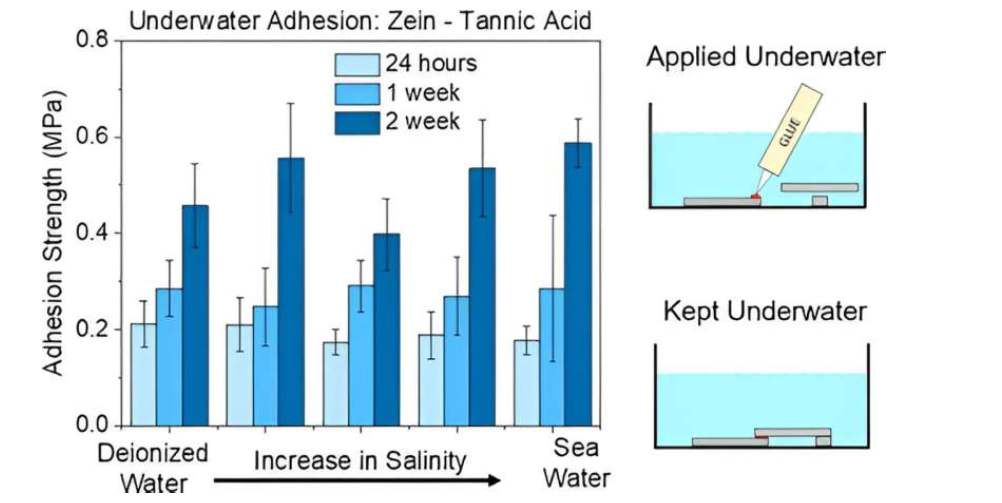
Derived from bio-based components including zein, which is a protein found in corn, and tannic acid, the adhesive was tested in various underwater experiments using different surfaces and different waters, such as seawater, tap water, saline solution and deionized water.
 Source: ACS Applied Materials & Interfaces (2023). DOI: 10.1021/acsami.3c04009
"Interestingly, the water type does not influence performance a great deal, but the substrate type does," the researchers explained. "An additional unexpected result was bond strengths increasing over time when exposed to water, contradicting general experiments of working with traditional, petroleum-based glues. Initial adhesion underwater was stronger compared to benchtop adhesion, suggesting that water helps to make the glue stick underwater."
The researchers added that when the adhesive was placed under water, a protective skin immediately formed on the surface of the adhesive that acted as a barrier for keeping water from entering the rest of the material. However, the skin could be broken to encourage expedited bond formation, the team suggested.
The glue, which can be manufactured easily and inexpensively, could be used for a variety of applications including coral reef restoration, as well as in the construction, manufacturing, biomedical, dental, food and cosmetic and other industries that require adhesives to work in water.
The new adhesive is detailed in the article “Underwater Bonding with a Biobased Adhesive from Tannic Acid and Zein Protein,” which appears in the journal ACS Applied Materials & Interfaces.