Coating magnifies steam-cycle power plant efficiency
S. Himmelstein | October 13, 2023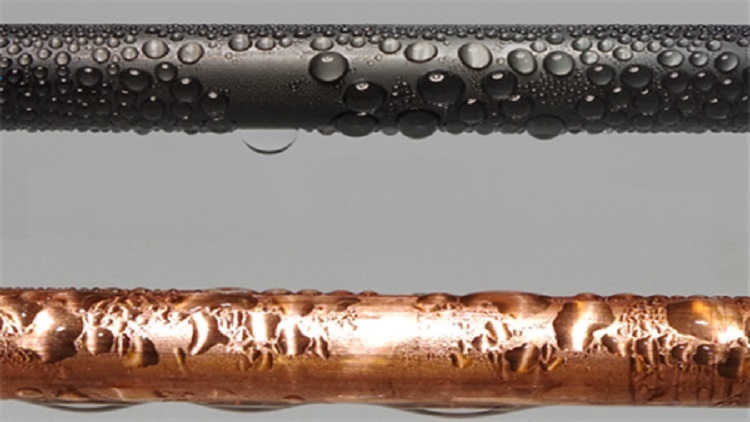 Copper steam condenser pipes coated with F-DLC (top) and without a coating (bottom). The F-DLC coating allows the condensed water to form into droplets rather than a thin film covering the pipe. Source: University of Illinois
A new type of coating tailored for steam condensers used in steam-cycle generation could boost process efficiency by 2% at coal- and natural gas-fired plants. Such an increase could reduce carbon dioxide emissions by over 400 million tons annually and cut power sector water consumption by 2 trillion gallons.
The durability of the coating composed of fluorinated diamond-like carbon (F-DLC) was demonstrated by subjecting treated metals to steam condenser conditions for 1,095 days. The hydrophobic properties of the treated components were maintained during this period.
The F-DLC coating improves heat transfer precisely because the material is hydrophobic. When the steam condenses into water, it does not form a thin film that coats the surface, like water does on many clean metals and their oxides. Instead, the water forms droplets on the F-DLC surface, putting the steam into direct contact with the condenser and allowing heat to be directly transferred. Heat transfer properties are improved by a factor of 20, which translates to a 2% overall process boost.
A study on the heat transfer-enhancing coating developed by researchers from the University of Illinois, MIT, Oerlikon Balzers Coating (Illinois) and Sabanci University (Turkey) is published in Nature Communications.