Team turns LEGO robot into gradient mixer
Marie Donlon | August 30, 2023Bioengineers from Arizona State University (ASU) are transforming a LEGO robot into a gradient mixer for use as part of the process for creating DNA origami nanostructures.
The researchers explained that creating DNA origami structures requires the purification of DNA origami nanostructures, a process which is typically accomplished via rate-zone centrifugation and an expensive gradient mixer.
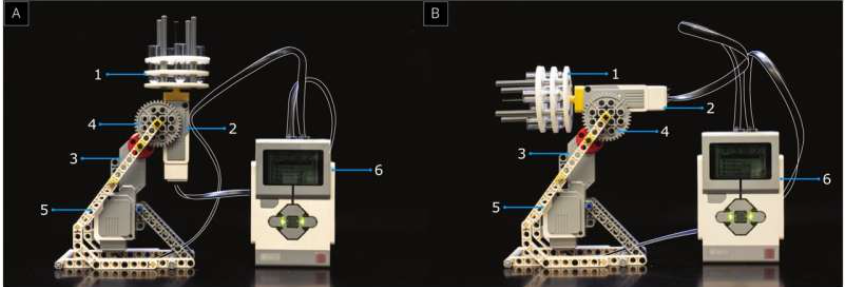 Side view of the LEGO gradient mixer during (A) its initial position and (B) its horizontal tilting phase. (1) 3D printed centrifuge-tube holder. (2) Spinning motor to rotate the tubes while in horizontal position. (3) Turning servo motor responsible for tilting the tubes horizontally. (4) Large grey gear connecting the two motors with its small gear complement. (5) The scaffold holding the structure together. (6) The LEGO controller for orchestrating the motions of the two motors. The black cables are traced in white for clarity. Source: Sentosa et al., PLOS ONE (2023) CC-BY 4.0
To lower the cost of developing such expensive equipment, the ASU team reportedly built a mixer using off-the-shelf LEGO kits.
According to the developers, traditional gradient mixers spin material inside cylindrical tubes. Ahead of this spinning, however, ingredients must be poured into the tubes, which must first be positioned vertically. As soon as the tubes are capped to prevent spilling, they are positioned horizontally and subsequently spun, thereby separating the material in the liquid into a gradient.
To mimic this via a LEGO robot gradient mixer, the team constructed a base and built a single-arm robot on top of it where the arm can hold and guide a platform to which the tubes can be connected.
Like an actual mixer, as soon as the tubes are filled and capped, the robot arm will slowly spin the tubes to mix the contents The tubes are then vertically positioned and spun rapidly, according to the researchers.
The team suggests that the LEGO robot successfully mixed and separated the materials comparable to the actual gradient mixer and they believe that other expensive lab equipment could be similarly constructed using LEGOs.
The findings are detailed in the article, Gradient-mixing LEGO robots for purifying DNA origami nanostructures of multiple components by rate-zonal centrifugation, which appears in the journal PLOS ONE.