Lower-Cost Solar Cells Without Doping
By Engineering360 News Desk | February 05, 2016Silicon solar cell fabrication typically involves impurity doping, a process that enhances electrical conductivity but that may add complexity and cost to manufacture. The doping step may be eliminated entirely, thanks to a new mix of materials developed by an international research team that yields solar cells with efficiencies comparable to those of doped devices.
Most of today’s solar cells use crystalline silicon wafers. The wafer itself, and sometimes the layers deposited on the wafer, are doped with atoms. These atoms either have electrons to spare when they bond with silicon atoms, or alternatively generate electron deficiencies, or “holes.” In both cases, the doping enhances electrical conductivity.
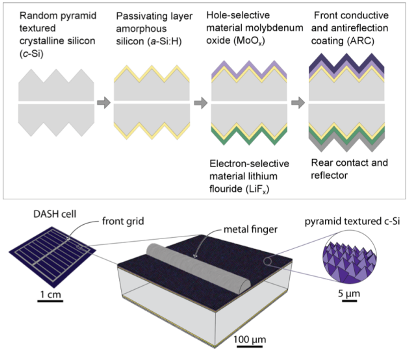 Artist’s rendering of how the DASH cell operates. Image source: Berkeley LabIn these devices, two types of dopant atoms are required at the solar cell’s electrical contacts. This helps to regulate how the electrons and holes travel in a solar cell so that sunlight is efficiently converted to electrical current that flows out of the cell.
Crystalline silicon-based solar cells with doped contacts can exceed 20% efficiency, meaning more than 20% of the sun’s energy is converted to electricity. A dopant-free silicon cell had not previously exceeded 14% efficiency.
The new study, though, demonstrated a dopant-free silicon cell, referred to as a DASH cell (dopant free asymmetric heterocontact), with an average efficiency above 19%. The increased efficiency is a product of the new materials and a simple coating process for layers on the top and bottom of the device. Researchers showed it’s possible to create their solar cell in seven steps.
In the study, the research team used a crystalline silicon core (or wafer) and applied layers of dopant-free type of silicon called amorphous silicon. Ultrathin coatings of were applied to the sun-facing side of the solar cell, and lithium fluoride at the bottom surface. The two layers, with a thickness measured in tens of nanometers, act as dopant-free contacts for holes and electrons, respectively. Both materials are transparent and have complementary electronic structures well-suited for solar cells.
The team used a room-temperature technique called thermal evaporation to deposit the layers of lithium fluoride and moly oxide. The research was conducted by researchers from Australian National University, U.S. Department of Energy’s Lawrence Berkeley National Laboratory, University of California (Berkeley) and the Swiss Federal Institute of Technology of Lausanne.