Finding New Semiconductor Materials Through 'Doping'
Tony Pallone | March 08, 2018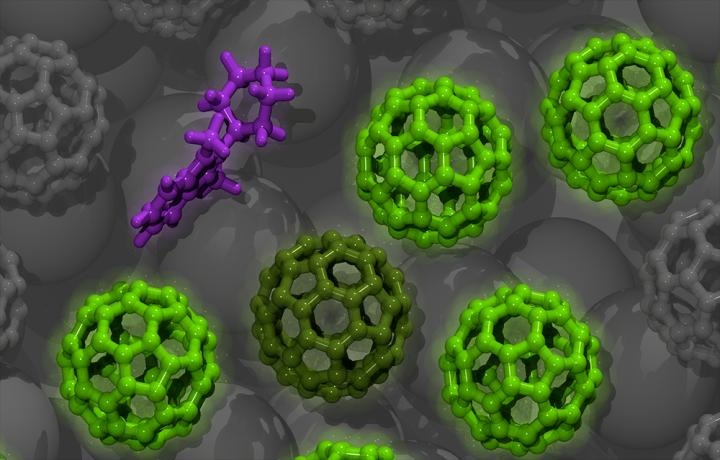 Dopant 2-Cyc-DMBI (purple) donates an electron to nearby C60 molecule (dark green), resulting in organic semiconductor molecules (light green). Source: S. Hutsch/F. Ortmann, TU Dresden.
What in the world is semiconductor doping?
If the phrase makes you wonder if we’re talking about electronic components taking performance-enhancing drugs, you wouldn’t be all that far off. The process of “doping,” in this context, introduces impurities into a material in order to give it semiconducting properties.
While silicon has long served as the “go-to” semiconductor material, researchers in recent years have studied a wider materials range -- including molecules that can be tailored to serve specific electronic needs. These complex semiconducting materials can be studied on their fundamental level through the use of supercomputers.
A team of scientists at Technische Universität Desden (TU Dresden) looking to refine its method for studying organic semiconductors has been using the SuperMUC supercomputer at the Leibniz Supercomputing Centre for that very purpose. The technology helps them to understand the semiconductors’ limitations and respective efficiencies.
Doping works because changes to a material’s physical properties also represent changes to electrical properties. In some cases, even a slight atomic alteration can have a profound effect on something like electrical conductivity. To understand what’s happening, the quantum laws that govern interatomic and intermolecular interactions must be calculated on an individual atomic level; in the case of the TU Dresden team, interactions are predicted with a computational method known as density functional theory, or DFT. They are also corroborated with experimental spectroscopy data.
The team tested its computational approach by simulating materials that already had solid experimental datasets and established industrial applications – such as Buckminsterfullerene (C60), a molecule with a structure similar to a soccer ball that is used in solar cells; and zinc phthalocyanine (ZnPc), a flat metallic molecule used in photovoltaics. A well-studied molecule called 2-Cyc-DMBI was used as a “dopant.” The result was good agreement between simulations and experimental observations.
The same methods are now being used by the team with more complex molecules and dopants. Next-generation supercomputers, meanwhile – such as the SuperMUC-NG that will be installed later in 2018 – will serve to expand the scope of simulations and lead to ever-bigger efficiency gains in a variety of electronic applications.
The team's research was recently published in the journal Nature Materials.