Efficiency of 26% achieved by these solar cells
S. Himmelstein | April 20, 2021Record efficiencies of around 26% have been limited to interdigitated back contact solar cells with both metal contacts at the rear. However, front and back contact (FBC) silicon cells have emerged as the industry standard and the preferred choice in industrial production due to their lower complexity. Now the conversion efficiency of these devices also reaches 26%, thanks to research conducted at the Fraunhofer Institute for Solar Energy Systems, Germany.
The elevated efficiency achieved is attributed to the design of the back-side cell surface as a full-area 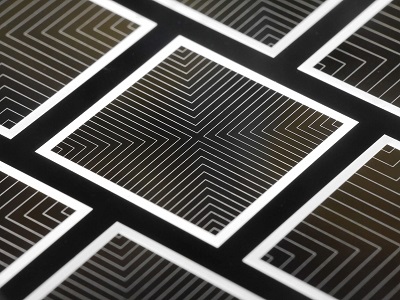 A new world record efficiency of 26% was posted for FBC cells. Source: Fraunhofer Institute for Solar Energy Systemscharge-carrier collecting passivating contact. The FBC cell was designed with tunnel oxide passivating contact (TOPCon) technology, developed at the institute, which combines the advantages of very low surface recombination losses with efficient charge carrier transport. Industrial standard cells have a p-n junction on the front side but this junction in the new cell was formed on the back side as a full-surface TOPCon contact. Local boron diffusion directly under the front-side contacts was implemented in place of the conventionally applied full-surface boron doping.
The TOPCon rear emitter solar cell allows higher voltages and higher fill factors than cells with a collecting emitter on the front side. The design enables improved use of the wafer for charge carrier transport. The front side is more effectively passivated with aluminum oxide.
The FBC cell architecture described in Nature Energy has the potential to reach efficiencies up to 27% in the near term.