Make Your Own Solar Cells
Ed Brown | December 09, 2016A research team from the Georgia Institute of Technology in the U.S. is working to simplify the fabrication of organic solar cells so that do-it-yourself kits for producing organic solar cells can be offered to the public.
The researchers developed a way of inducing p-type electrical doping in organic semiconductor films by briefly immersing the films in a solution at room temperature. The new method provides what they say is a simpler alternative to air-sensitive molybdenum oxide layers used for polymer solar cells, which requires processing with vacuum equipment.
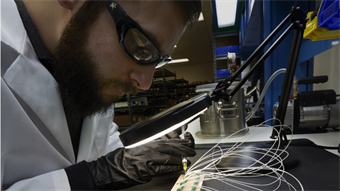
 Solar cells films doped by the new solution-based electrical doping technique. Credit: Christopher Moore/Georgia TechThe technique involves immersing thin films of organic semiconductors and their blends in polyoxometalate solutions in nitromethane. During this immersion dopant molecules are diffused into the films, leading to efficient p-type electrical doping at a depth of 10 to 20 nm from the surface of the film. The doped regions exhibit increased electrical conductivity and high work function, reduced solubility in the processing solvent, and improved photo-oxidation stability in air.
The unique geometry of these devices builds the functions of hole and electron collection into the light-absorbing active layer. This results in the simplest single-layer geometry with few interfaces.
"The realization of single-layer photovoltaics with our approach enables both electrodes in the device to be made out of low-cost conductive materials," says Senior Research Fellow Canek Fuentes-Hernandez.
The power conversion efficiency of organic solar cells has improved over time from 13% to about 20%. Although polymer-based cells remain less efficient, they require less energy to produce than silicon and can be more easily recycled.