Report: State policies push renewable energy growth
S. Himmelstein | August 09, 2023The U.S. state renewables portfolio (RPS) and clean electricity standards (CES) database maintained by U.S. Lawrence Berkeley National Laboratory has been updated to reflect trends through year-end 2022 and projections to 2050.
The revised data indicate that states continue to refine and revise their RPS policies, typically by adopting higher targets or broader CES policies. Among the 29 states plus Washington, D.C. with an RPS, 16 states have RPS targets of at least 50% of retail sales, and 17 have a 100% CES or RPS target.
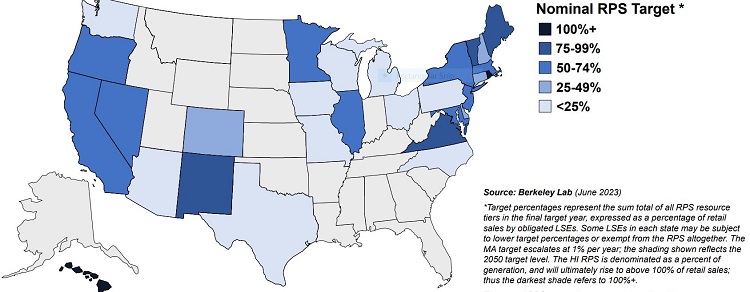 RPS policies exist in 29 states and Washington, D.C. Source: U.S. Lawrence Berkeley National Laboratory
About half of all growth in U.S. renewable electricity generation and capacity since 2000 is associated with state RPS requirements, a percentage that has fallen to represent 30% of all U.S. RE capacity additions in 2022. RPS policies play a more central role in motivating renewable energy growth in the northeastern and mid-Atlantic U.S. relative to other regions.
These policies will require roughly 300 TWh of additional clean electricity supply by 2030 and 800 TWh by 2050, pointing to the need for total non-hydro renewable energy generation to reach 28% of electricity sales by 2050, as compared to 17% today.
Prices for solar renewable energy certificates remained relatively stable over the last year and continue to exhibit wide variation across states, with the highest prices of $200/MWh to $450/MWh in New Jersey, Massachusetts and Washington, D.C.