How to use 3D printing for production tooling
Scott Orlosky | July 11, 2023The phenomena of 3D printing is a great example of how technology progresses. “Printing layers of sticky, melted plastic” hardly sounds like the beginning of a revolution in manufacturing. But we have examples from other industries. The original computers were the size of refrigerators and cost a million dollars each, and look at where they have evolved to be today. Phones, laptops, tablets – they’re everywhere and we use them to run our lives. Similarly, the additive manufacturing (AM) revolution has taken 40 years to fully materialize, but there is no doubt that the technology is here to stay and it has changed the face of manufacturing dramatically. The technology is inexpensive enough that anybody who wants to can afford it. In today’s world of 3D printing, if you can dream it, then you can make it.
Process evolution
The first conceptual 3D printers relied on stereo lithography (SLA); essentially a liquid that hardens when activated by a laser beam. Although polymers were the material of choice for the first 3D printed parts, they have now evolved to versions that can use metals through a selective laser sintering (SLS) process. Sintering is welding fine particulates together with a highly focused laser beam. Essentially, just about any sort of mechanical property that would be required can be printed using either of these two processes or a third method: fused deposition modeling (FDM), which uses a plastic filament fed through a heated tip. Typical high-performance plastics are Ultem, PEEK and nylon. On the metals side, titanium, aluminum and stainless steel are common.
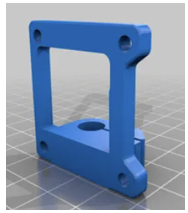 Figure 1: A 3D-printed mounting bracket.
Application explosion
With the range of materials and processes available, 3D printing became known more generally as AM, which is the opposite of subtractive manufacturing, (also known as traditional machining). The versatility of AM and the reduced costs over time for this equipment means that they can be used to build incredibly complex shapes, like rocket nozzles for example, as a single part, while improving the weight and integrity of the parts. AM now exists in most fields: medical, machinery, consumer, automotive, fashion, manufacturing, aerospace, military, robotics, art and so on. It boggles the mind.
In the manufacturing environment
Focusing in on one area, manufacturing, can give us some insight as to where and how AM has changed the view of this sector. The first thing to understand is that most manufactured items are first built in virtual space using a CAD/CAE (computer-aided design/computer-aided engineering) software program. When designing parts to be produced with an additive process, the designer needs to think differently about the design from the start. To fully take advantage of the benefits of AM, it’s not unusual to make a few versions of the original prototype, to check how the finished part will integrate through the full assembly and test process. In the early stages the designer will want to take full advantage of the AM properties:
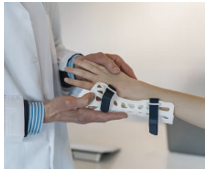 Figure 2: 3D-printed wrist brace.
- The ability to produce “impossible to machine.” or “difficult to machine” parts
- Incorporate threads that are formed directly in the part
- Allow for more organic shapes unconstrained by conventional subtractive processes
- Incorporate internal passageways for vacuum/pressure or access if needed
- Combine multiple piece assemblies into a single, lighter weight piece
- Place alignment targets directly into the finished piece to help with assembly
- Provide features on mating parts that only allow one correct assembly configuration
This requires a different mindset and an understanding of what is possible depending on the type of AM equipment being used. In some design shops, they will use something like a high-impact plastic for initial prototypes, because it is inexpensive and gives the designer a chance to correct any part of the design. Then they will follow it with a metal part, which will be stronger, with a smoother finish and can take the rigors of being used in the actual application.
Fixtures and tooling
Peripheral to the manufacturing of finished production level parts is all of the support structure that goes into advancing the product through the manufacturing process. Fixtures, trays for aggregating assemblies for transport, alignment fiducials, pick and place operations, robotic end-of-arm tooling and so on — for almost all of these pieces of equipment, there is an AM solution. These can be made of high strength and stable plastics where appropriate or metal, if that level of precision and strength is required. Since the volumes for these things are usually low, AM is a very economical solution.
Think differently
Thinking about manufacturing in a different way through the use of AM technologies can have a profound effect on a company’s market approach. AM can become a communication tool to address the needs of a customer base. For example, suppose that 10% of the product shipping to customers today would be more effective with a slight modification. Could designers devise a way to include that modification as a simple add-on to the base model, or iterate a few design ideas in cooperation with customer design teams to capture this higher added value? This concept is analogous with the agile development process often used in the software field.
And beyond
In the course of a couple generations, 3D printing has grown and evolved to a powerhouse industry (with annual sales of nearly $20 billion and growing at 20% per year) helping catalyze advancement in just about every industry it touches. It’s a remarkable feat and has even changed the way we think about how we build things for the future. In some places, it can have a direct profound effect on people’s lives; in the medical industry, custom fitted casts are already available, while synthetic skin for burn victims is in the laboratory development stages. However, it also fundamentally changes our relationships in other ways. In the near future, you could troubleshoot and fix your broken dishwasher by choosing a part from a schematic and having it printed directly on your home 3D printer. That’s something worth thinking about.
About the author
Scott Orlosky has an MS in Manufacturing and Control Theory from the University of California at Berkeley and has worked over 30 years designing, developing, marketing and selling sensors and actuators for industrial and commercial industries. He has written numerous articles and application notes for speed and position sensors used in industrial and hazardous area environments including an author credit in “Encoders for Dummies.” Scott authored an industrial newsletter for nearly 15 years and is also co-inventor on a number of patents involving design and manufacturing of inertial sensors.