
A digital twin for the first commercial fusion facility
S. Himmelstein | July 28, 2023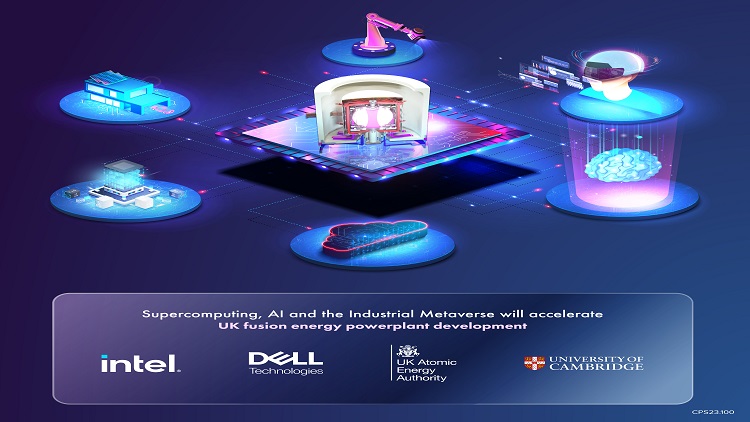 Supercomputing, artificial intelligence and the Industrial Metaverse will advance development of the U.K.'s prototype fusion powerplant. Source: UKAEA
Plans for hosting the world’s first commercial nuclear fusion power plant in the U.K. have taken a digital turn. The U.K. Atomic Energy Authority (UKAEA) intends to develop a digital twin of the Spherical Tokamak for Energy Production (STEP) prototype fusion power plant slated for construction at the site of a former coal-fired power plant in Nottinghamshire.
The agency will collaborate with the University of Cambridge, Dell Technologies and Intel to create the plant in a virtual environment known as the “Industrial Metaverse.” The digital twin will enable the UKAEA to assess the feasibility of the project before commencing construction. The concept design is due to be completed by 2024.
Exascale computing and artificial intelligence with advanced predictive capabilities will be used to provide powerful analytics to test STEP’s initial concepts. The digital twin will enable engineers to create a robust design in the virtual world to ensure ecosystem readiness and to help STEP achieve its goal of delivering electricity to the grid in the 2040s.
[See also: A STEP toward fusion in the U.K.]
The supercomputer at the Cambridge Open Zettascale Lab will leverage Dell PowerEdge servers based on 4th Gen Xeon processors to run the massive amounts of modeling and simulations needed for this research.
Intel oneAPI tools will allow developers to use a single codebase to deploy applications across multiple architectures and address code portability — one of the biggest inhibitors of simulation functionality and performance.



I don't understand. Why are they building fusion plants when they haven't got fusion to work yet? Aren't they putting the cart before the horse? And couldn't the money spent on that be used to accelerate the development of fusion energy?
I much agree with Papadoc. A "digital twin" of a working facility is useful for predicting the consequences of changes to the facility. This digital twin of a facility that doesn't work yet may simply tell us how much simulated energy isn't coming out of the powerplant. Akin to the cartoon "And now, a miracle occurs."