The Maker Revolution Gains Traction
Jean Thilmany | February 09, 2016Maker spaces have sprung up around the globe in recent years. Typically featuring advanced hardware and software, they are intended to help today’s inventors and do-it-yourselfers create innovative products for their own uses and for their communities. This step toward individual fabrication represents something of a revolution that has the potential to rival earlier revolutions in digital communication and computation, says Neil Gershenfeld, the Massachusetts Institute of Technology professor behind a large subset of these maker spaces.
(Subscribe to our Creative Engineering newsletter.)
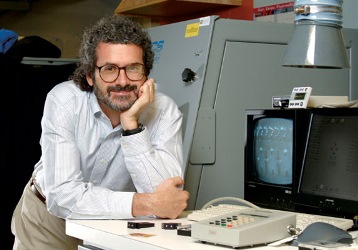 Neil Gershenfeld, director of the Center for Bits and Atoms at MIT.
Makers conceive, design and build products, and if they’re not engineers themselves they certainly take a page—or several—from the engineering handbook. The impact they might have for future technology and invention can be monumental, says Gershenfeld, who’s had a big hand in helping create and grow these spaces. He’s director of the Center for Bits and Atoms at MIT.
In 2001, the center spawned the fab lab concept, which is a type of fabrication laboratory or maker space that can be used by anyone and that acts as a distributed laboratories for research and invention, he says. They allow community members to tinker with and engineer their ideas in ways they’d never be able to without access to tools like 3D printers, laser cutters, numerically controlled milling machines, electronic components, and programming tools.
“The increasing accessibility of space and time means a relatively modest facility can be used to create physical forms as fine as microns and to program logical functions as fast as microseconds, Gershenfeld writes in his book Fab: The Coming Revolution on Your Desktop—from Personal Computers to Personal Fabrication (Basic Books, 2005). In the book, he tells the story of the fab labs’ creation and posits that consumers soon would be able to design and produce their own products in their own homes with software and a machine that combine consumer electronics and industrial tools.
In the decade since he wrote his book, more than 560 fab labs have opened around the world, says Sherry Lassiter, president of the Fab Foundation, which supports the international fab lab network. They’re often located in libraries, schools and community centers, and often are overseen by people with some engineering training and who know how to operate the hardware and software.
Transforming Communities
The maker space concept is potentially life-altering in the developing world, where a Fab Lab with just $20,000 worth of laser cutters, milling machines and soldering irons can transform a community by helping people build tools, fabricate replacement parts and develop essential products otherwise unavailable in the local market, she says.
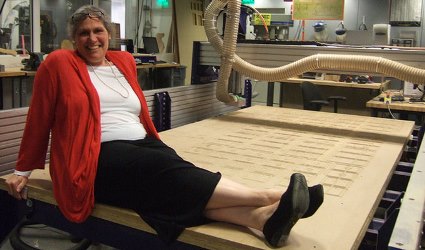 Sherry Lassiter, President, Fab Foundation.In Takoradi, Ghana, for example, people used the labs to produce a cassava grinder, car parts, agricultural tools, and communication equipment such as radio antennas. In Norway, herders used fab labs to make radio collars and wireless networks to track their animals.
In June 2015, the Aurora, Ill., public library debuted its own fab lab, which is open to anyone who wants to come in for “anything that involves making,” says Mark Sloan, the library’s assistant manager of digital services. “We don’t even check library cards,” he says. Most libraries are proponents of lifelong learning and open access to knowledge and information. That mission statement virtually requires them to provide citizens with “far more than traditional books, although we still love books,” Sloan says. “That’s the reason for the fab lab.”
The Aurora lab includes three 3D printers, a laser cutter, a vinyl cutter, an Oculus Rift—the soon-to-be-released virtual reality system that allows an immersive experience--and smaller pieces of hardware, including Moss robotic building blocks, Raspberry Pis—a credit-card sized computer on which to learn programming--and littleBits, which are electronic building blocks.
“A lot of the equipment that the public has access to in a fab lab is too expensive for your average person to purchase and put in their garage,” Sloan says. “But the library can make a community purchase that lets everyone with an interest to come in and learn how to design on a laser cutter, for example.” Sloan, along with colleague Himanshu Trivedi, manage up to eight digital service assistants (when the library is fully staffed) who oversee the lab, a media studio, the public computer areas, study rooms and a training lab.
STEM Outreach
Meanwhile, Fab Lab Cockermouth in Cockermouth, England, is open to local businesses that can seek help with two- and three-dimensional design and with digital manufacturing and prototyping, says Danny Frost, the lab’s co-manager. The lab also runs a free program in nearby schools and offers each program up to two free days in the fab lab. With a contribution to material, students can take their projects back to their schools to continue work on them or to have access to their completed projects. So far, the lab has worked with about 20 local schools under the program, Frost says.
Sally Phillips, who owns Chimney Sheep in the Cockermouth area, used the fab lab services to create the prototypes and eventually the product for her business. Fab lab staff created the chimney sheep prototypes, and she came in frequently to have a say in the design and prototype process.
The wool chimney sheep is a bit larger than a fireplace flue and grips the sides of the flue to hold itself in place. This closes gaps and keeps cold air from sweeping down the chimney and into the room. The sheep includes a 6-inch handle and 6-inch extension rod, and can be extended another 12 inches for placement. Although it is low-tech, the wool had to be the right degree of “squishiness;” the handle had to be easy to use, extendable and fire retardant; and the wool head had to be the right size to fit as many chimneys as possible without being too complicated.
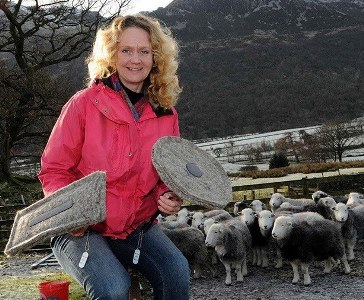 Sally Phillips used a fab lab to build a prototype of her chimney flue product. Image source: Fab Lab Cockermouth.
“Going from some handmade prototypes to a product that could be made commercially took a while,” she says. “It was great to be able to pop into the fab lab and watch my prototype product being made.” This project used the fab lab’s Dimension 1200es Series 3D printer. The main software used was an AutoCad drawing that Phillips’ manufacturer supplied.
Although neither the maker space nor fab lab concept has yet to spawn another digital revolution, their future is bright. They might lead, as Gershenfeld predicts, to small machines like 3D printers perched on a desk that give a maker access to a complete manufacturing plant right at home.