Video: Elastocaloric cooling tech is heating up
S. Himmelstein | July 24, 2023A high-performance elastocaloric cooling system has been devised as an environmentally friendly alternative to established air conditioning, refrigeration and other cooling technologies. The prototype system engineered by researchers from the University of Maryland and Beihang University (China) eschews the use of chemical refrigerants, eliminating reliance on such substances with high global warming potential.
Rather than using a refrigerant circuit containing a working fluid, the device instead relies on pushing and pulling pieces of metal to initiate phase transition and create cooling. A key feature is the compression and release of fatigue-resistant nickel-titanium tubes configured in a versatile, multimode heat exchange architecture.
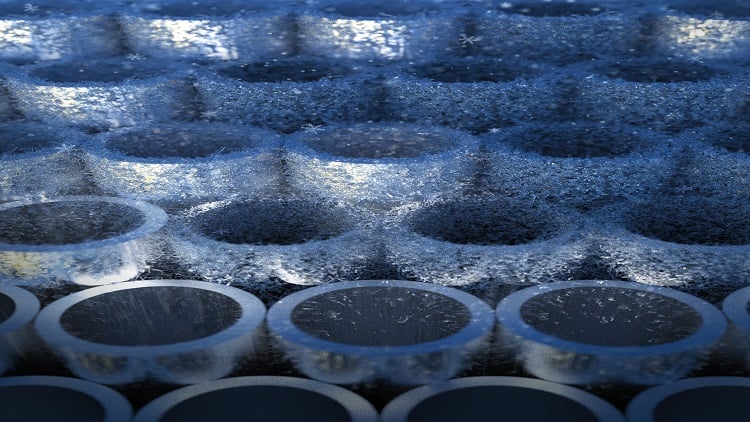 Metallic solid-state refrigerant tubes used for elastocaloric cooling, an environmentally friendly refrigeration technology. Source: Jiaqi Dai/University of Maryland
The cooling scheme uses a hydraulic actuator for compressing the tubes, but these components are too large, costly and inefficient. Future iterations will be designed with new copper-based elastocaloric materials and driven with a smaller stress actuator.
The current iteration can produce 260 W of cooling capacity, enough to power a small refrigerator. The researchers expect to expand the technology described in the journal Science to window units, whole-house cooling systems and eventually to commercial HVAC systems.