Measuring thermal expansion in solids
Seth Price | July 05, 2023Thermal stress is a common killer of materials, particularly ceramics. A hot mug placed in a sink full of cold water may shatter. A windshield left facing a hot summer sun may develop thin cracks lengthwise due to uneven heating.
To understand thermal stresses, one must examine thermal expansion. Heat added to a material increases the vibrations in the atoms, causing them to take up more physical space. Therefore, the material actually grows in size as it is heated.
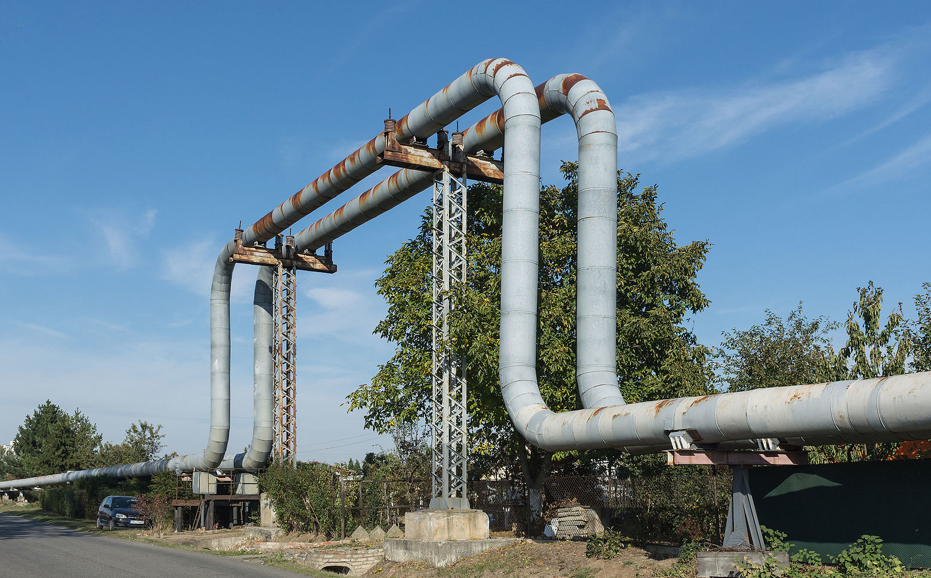 Figure 1: Thermal expansion must be accounted for in engineering designs. This thermal expansion pipe loop allows the pipe to expand and contract without buckling. Source: Jacek Halicki/CC BY-SA 4.0
As it turns out, thermal expansion is used to determine the temperature in many sensors. A simple glass thermometer takes advantage of the fact that mercury (or more commonly dyed red alcohol) expands much more quickly than glass. As the temperature increases, the liquid is forced from the reservoir up through a capillary tube that is calibrated with temperature.
The difference in thermal expansion between different materials is used in many thermal switches and thermostats. Two thin strips of different metals are stuck together. As they are heated, one expands faster than the other, causing the apparatus to bend in one direction or another, triggering a switch to turn on a heater or cooler.
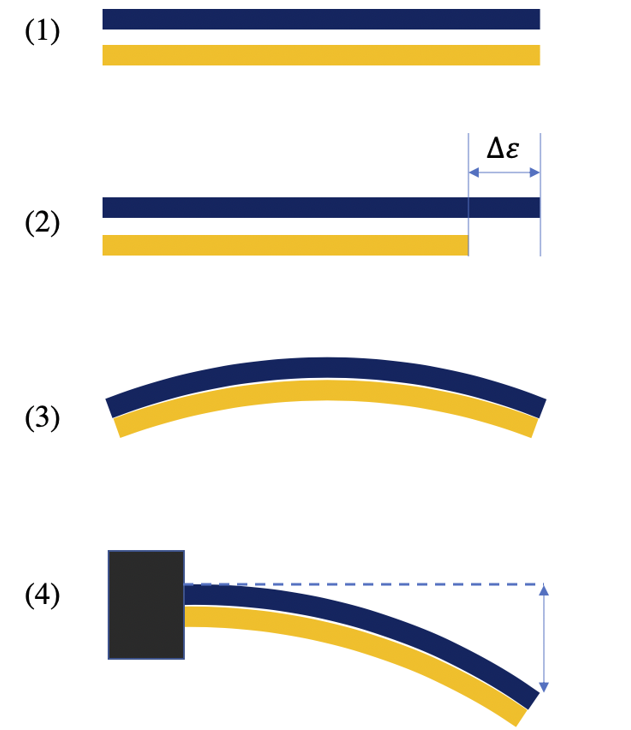 Figure 2: Bimetallic strip used in a thermostat control. Image 1 is two materials of the same length, 2 represents the difference in expansion between the metals. Images 3 and 4 demonstrate how the assembly will bend due to the difference in expansion. Source: Ltncanada/CC BY-SA 4.0
Thermal expansion is important, but how does one quantify it? As with most materials measurements, thermal expansion is measured in a controlled environment and then these quantities are used in the rest of the required engineering calculations for determining the suitability of a material in a specific application.
What is linear thermal expansion?
Thermal expansion occurs in three dimensions. As the atoms vibrate, they do so in all directions, meaning the material grows in all directions. This makes calculating the thermal expansion and the associated thermal stresses in complex geometries difficult to calculate analytically. It is also difficult to measure.
Instead, an easier quantity to determine is the linear thermal expansion. Linear thermal expansion is the expansion in only one dimension. For isotropic materials, this linear expansion can be used to find the overall thermal expansion, with the help of thermal modeling software. For anisotropic materials, linear thermal expansion must be measured in all relevant directions. This means the samples should be cut in such a way to measure along the x, y and z of the material. From there, the modeling software can make sense of how the final product will behave during heating.
Dilatometer
A dilatometer is a device that measures linear thermal expansion of solid materials. The most basic dilatometer consists of several components: a heater, a controller and a linear variable differential transformer (LVDT), which is used to measure length.
The sample is placed in a ceramic furnace, suspended between one wall of the furnace and a spring-loaded ceramic pushrod. As the furnace heats up, the sample expands and pushes against the spring-loaded pushrod. At the other end of the pushrod is the LVDT, which measures the linear displacement of the pushrod.
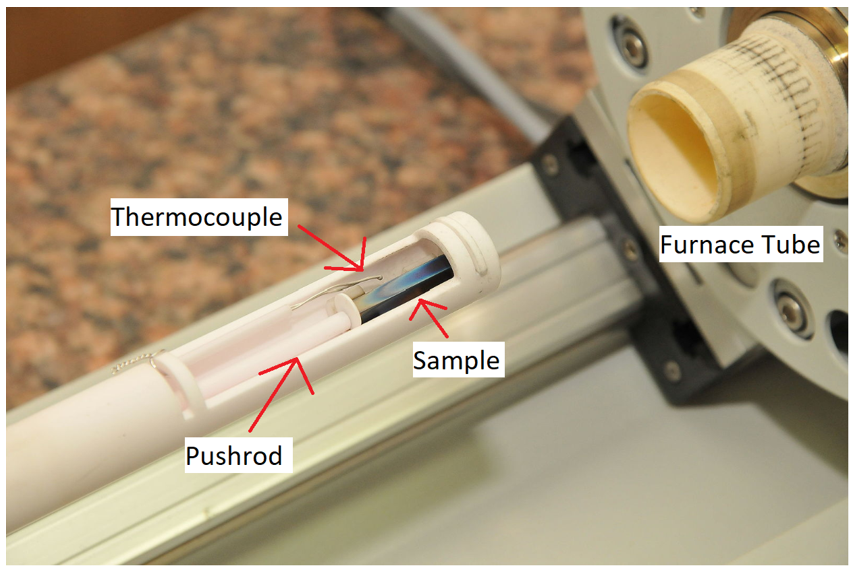 Figure 3: In this image, the furnace is shown to the right and the furnace tube on the left. Inside the furnace tube is a small steel sample, being held in place by a pushrod and the end of the tube cylinder. The furnace slides over the tube, placing the sample and control thermocouple in the heating zone of the furnace. Source: MadCAD/CC BY-SA 4.0
In order for this data to be valuable, the temperature of the furnace must be tightly controlled. This means there is at least one thermocouple present in the chamber, and slow ramp rates (under 10° C/min) must be used to ensure that the sample is near the temperature measured at the thermocouple.
Thermal expansion and other measurements
The output from the LVDT is plotted against the furnace temperature. From there, the slope of the linear sections of the graph demonstrates constant thermal expansion. Areas that are nonlinear can indicate material phase changes, where some of the thermal energy is going into reorganizing the molecular structure.
It is also a way to determine when a ceramic material might sinter. A green sample is placed in the dilatometer and heated. Sintering will show up as a non-linear region, perhaps flattening out where there is little thermal expansion with increased temperature. This marks the starting temperature of the sintering process. Additional samples can be soaked at this temperature until thermal expansion begins again. This will indicate the time required for complete sintering of the rod. It makes a starting point for determining the sintering routine and experiments can fine tune the routine for a specific part.
By ramping the temperature up and then ramping it back down, shrinkage can be determined. This is particularly useful to see how a material is permanently deformed during heating. The heating ramp and the cooling ramp are overlaid. If they are similar, the material did not deform significantly. If there is hysteresis in the graph, the material permanently deformed during heating.
Special considerations
To make the most out of dilatometer data, there are numerous considerations. First, the sample material must be suspended between the furnace wall and the pushrod without dragging on any surface. This additional friction can reduce the perceived thermal expansion, and can also damage the dilatometer, if material sinters to the furnace tube. Along the same lines, the pushrod must be adjusted so that the spring tension is just enough to suspend the sample, not enough to hamper expansion. If the sample is loaded into compression, it will look like the thermal expansion is lower than it is in reality.
Materials that sag
Consider a glass rod. As the temperature increases, the glass will begin to flow under its own weight. It will no longer be able to push against the pushrod and the pushrod will move forward, which will look like the material contracted. Not only is this inaccurate, but the glass can damage the dilatometer by poisoning the furnace tube walls.
To combat this, some controllers have a built-in routine that looks for contractions above a certain percentage. Should the material contract, the furnace will shut off, preventing further flow of the material.
Comparing to a standard
Almost all materials experience thermal expansion, including the furnace and furnace tube. Therefore, for the most accurate results, a “zeroing” run must be conducted, where a sample of alumina is run through the same firing routine. This data is then subtracted from the results to remove the thermal expansion of the furnace from the data.
Some dilatometers have dual pushrods, one for a standard and one for the sample under test. This ensures that the identical heating routine is applied to both, and the furnace expansion is subtracted automatically.
Final thoughts
While there is no specific, growing field for thermal expansion research, dilatometry plays an important role in all of the engineered structures that are being constructed. From preventing buckling in sidewalks to ensuring that the latest semiconductor chip is not delaminating from its packaging, thermal expansion measurements and thermal modeling will always be part of sound engineering design.