Material changes color when medications get too warm
Marie Donlon | June 25, 2023A team of researchers from Shenzhen Institute of Advanced Technology has developed a technique that could indicate when medicines and foods that require refrigeration have exceeded safe limits.
To accomplish this, the team turned to colored microcrystals in materials that turn colorless over a range of temperatures and response times. To develop their proof of concept, the team incorporated the color-changing materials into a vial lid featuring a QR code.
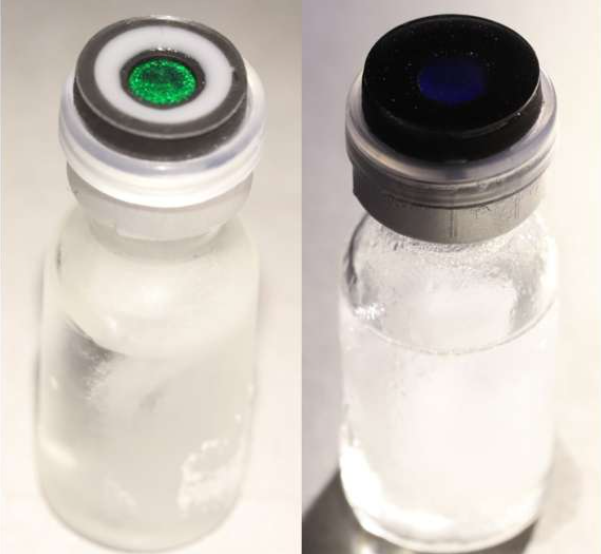 Appearing green on a vial lid (left), this structural color material becomes colorless (right) when warmed. Source: Adapted from ACS Nano 2023, DOI: 10.1021/acsnano.3c00467
Current technologies used to provide visual indicators of temperature changes tend to produce less electronic waste than the array of wireless sensors used to monitor the temperature of individual products. However, techniques that rely on colorful reactions or dyes that produce hues can fade or may only monitor above-freezing temperatures — an approach that doesn’t help with products such as COVID-19 vaccines that tend to break down below freezing (above -4° F or -94° F).
As such, the team sought to create an improved color-changing material featuring tunable melting for tracking a wide range of temperatures and turned to structural colors in lieu of dyes to develop their indicator system.
The team created glycerol-coated silicon dioxide nanoparticles, which when clustered together as microcrystals in water looked bright green or red. Liquids featuring variable melting points were then developed by mixing various concentrations of polyethylene glycol or ethylene glycol and water. According to the researchers, the two parts combined produced an irreversible color loss in the event the temperature-triggered solution melted and the microcrystals broke down.
The materials could eventually be tailored to track temperature exposures ranging from -94° F to 99° F, potentially lasting from minutes to days.
The research is detailed in the article, “Self-Destructive Structural Color Liquids for Time-Temperature Indicating,” which appears in the journal ACS Nano.