Safer medical imaging with solar cell material
S. Himmelstein | June 06, 2023A material that shows promise as a visible light harvester in photovoltaic applications can also be tapped as an X-ray absorber component to reduce the X-ray dose rate administered to patients during medical imaging.
An international research team demonstrated that bismuth oxyiodide (BiOI) detects X-ray dose rates over 250 times lower than commercially used detectors and offers scope to make medical imaging safer. Single crystals of the nontoxic semiconductor prepared by a scalable vapor-based approach are characterized by low defect densities and stable, ultra-low dark currents, which lend themselves to enhancing material sensitivity and detection limit to X-rays.
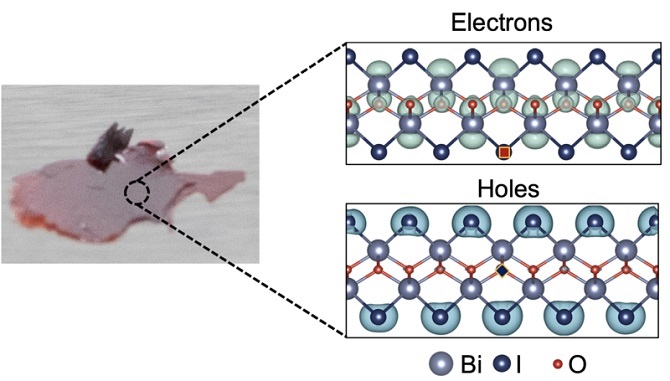 Photograph of BiOI single crystal; diagrams depict the structure of each layer. Source: University of Oxford
Energy losses associated with electron movement in the BiOI lattice are effectively prevented by applying an electric field to rip away electrons from the lattice. In the presence of a small electric field, electrons can be transported over a millimeter length-scale, allowing the efficient extraction of electrons generated in the single crystals through the absorption of X-rays.
In addition to making medical imaging safer, the research published in Nature Communications expands new opportunities in non-invasive diagnostics, such as X-ray video techniques.
Scientists from University of Cambridge (U.K.), Queen Mary University London (U.K.), University of Oxford (U.K.), CNRS (France), Sun Yat-sen University (China) and Universität Heidelberg (Germany) participated in this study.