New wind turbine design could revolutionize wind power
Ryan Clancy | April 26, 2023A new approach to manufacturing wind turbine towers has emerged that could drastically change how onshore wind farms are deployed. This method, known as spiral welding, utilizes modular assembly and eliminates costly transportation costs by providing onsite construction. By streamlining the process of erecting towers and installing wind turbines, this new design promises to reduce time and cost while potentially increasing safety protocols dramatically.
What is spiral welding?
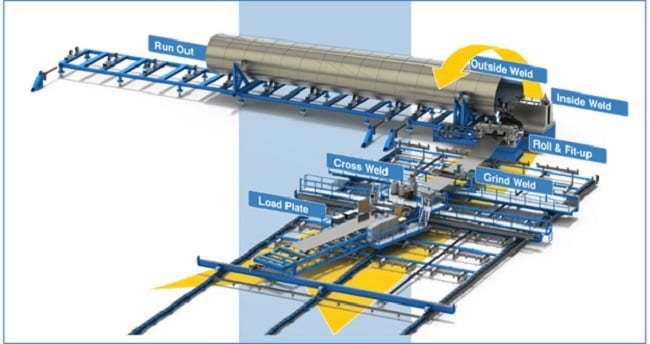
Spiral welding is a process where metal strips are twisted into a coiled shape that is then welded together at the joining edges to create a seam. This process is also known as helical or helix welding and is designed to create pipes with increased diameter for all types of uses. The most common application for spiral-welded pipe fabrication is in creating pipes used in oil and gas pipelines.
The process of spiral welding creates several benefits compared to traditional pipe fabrication processes. The spiral weld is designed to be stronger than a straight seam weld due to its shape, and it also requires less material. This makes spiral welding an excellent choice for when a large-diameter pipe is needed but traditional fabrication materials are in short supply.
Spiral welding offers precision in controlling the diameter of the final product. By altering thickness and width of strip steel used, a variety of pipes can be created without needing to purchase multiple materials. As a result, production costs are lowered due to fewer components necessary for each pipe construction. The process is most notably used by Keystone Tower Systems.
 Source: Keystone Tower Systems
Using spiral welding to construct wind turbines
Wind turbines constructed using spiral welding represent a significant advancement in the renewable energy sector. As reported by the U.S. Department of Energy, this innovative method allows for the construction of steel towers that are double the height and completed 10 times faster than those built with traditional techniques. The process involves cutting meters-wide steel plates into required shapes then welding them together with a specialized machine.
Due to its increased speed, using spiral welding reduces labor costs significantly while also saving time and resources. Additionally, the method eliminates the need for large custom-built tower sections, which further saves on materials costs and production time. Furthermore, due to its ability to weld multiple pieces of plate together simultaneously, it enhances productivity levels compared with traditional methods such as butt-welding and riveting.
In terms of safety, spiral welding requires no cutting or grinding, which reduces the risk of sparks and flames, making it a much safer alternative to other conventional techniques. It also does not require additional support structures or jigs for holding the components in place, which helps reduce construction costs.
The towers can be manufactured and assembled on-site at the wind farm, which eliminates transportation issues. As a bonus, the towers are also much lighter than conventional towers and require less steel to construct, making them much more affordable.
This method provides many benefits over traditional approaches when constructing wind turbine towers such as increased efficiency, reduced labor costs, improved safety and lower materials costs. With these advantages in mind, spiral welding looks like it could become very popular with renewable energy developers who are looking for efficient ways to construct large-scale wind turbines quickly and safely.
More advancements in wind turbine construction technology
The study conducted by researchers at the Universitat Politècnica de València, Spain, has opened up the possibility of developing more sustainable wind turbine designs. Through their work, they have proposed solutions that are 8% to 15% better in terms of energy efficiency when compared to traditional construction methods.
This advancement comes from the innovative and efficient method that they have developed for optimizing the design of wind turbine foundations. By using specialized software, this technique can analyze different conditions and optimize accordingly, meaning that structures can be designed in a more sustainable manner while also making sure that construction remains as easy as possible.
This is merely the beginning of how this technology can revolutionize wind turbines. Moreover, it could be applied to other construction elements such as blades, towers and generators. As researchers continue their work in this field, new sophisticated solutions are certain to arise that will make designing wind turbines more efficient and environmentally friendly.
[Discover more about wind turbine technology on GlobalSpec]
Vertical-axis turbines
Vertical-axis turbines are an innovation that has been garnering significant attention in the energy industry. By taking advantage of aerodynamic forces, these turbines yield power even under turbulent wind conditions where conventional horizontal-axis designs may not be effective. These turbines are the optimal solution for areas that often experience strong gusts of wind, consequently providing power while reducing dependence on conventional energy sources.
Bladeless wind turbines
Bladeless wind turbines are an intriguing advancement that could revolutionize the production of energy. These turbines can be placed in areas where traditional ones cannot function properly due to their noise and oscillations from the spinning blades. Instead, bladeless wind turbines rely on an oscillating motion to produce electricity quietly with minimal disturbance.
[See also: Wind energy trends and innovations]
Summary
The potential of novel wind turbine construction technology could have dramatically positive impacts on the sustainability of our energy resources. With advancements in research, more energy-efficient and eco-friendly designs are expected in the future. As these technologies continue to develop, renewable energy may soon become even cheaper than before.