
A green energy future will cost trillions
Gordon Feller | April 23, 2023
The future electric grid will be quite different because of the November 2021 Bipartisan Infrastructure Law (BIL). It includes funding for an incredible surge in investment in the U.S.’s vast transmission grid – already $65 billion – and it will likely be just the beginning of unprecedented grid improvements.
The BIL will pave the way for significant expansion and modernization over the coming decades and provide key opportunities for industries and companies prepared for renewables, energy storage and sustainable grid infrastructure.
Investments in the grid appear to be attributed to three critical drivers.
- Addressing aging grid infrastructure
- Improving network reliability and resilience
- Transitioning to lower carbon energy sources
It is this last one, lower carbon energy sources, which will likely generate the most visible, interesting and innovative investments. However, even if this is technically feasible, other obstacles remain. There are many challenges at play in this coming evolution of the grid, including technical, financial, social and political.
Evolving the North American electric grid
There are approximately 400,000 miles of transmission lines across the U.S. The grid is operated at high voltages (typically 69 kV to 765 kV), allowing for much more power through the wires than would be possible at distribution-class voltages (typically 5 kV to 25 kV), as power flow capacity increases with the square of the voltage. These lines connect the nation’s larger generating units to bulk substations, where the voltage is stepped down to the lower distribution class voltages through large power transformers. Source: U.S Dept of Energy
Most transmission lines are located above ground, running long distances through undeveloped land or along major highway routes. Increasingly, transmission lines are buried underground, when possible, or laid along lake or seabed to connect offshore renewables with the grid. Integrating distributed energy resources (DERs) like wind, solar and battery storage will be key to unlocking an electric future, one where a 2018 study found that electric vehicles alone will increase state-by-state electric energy needs by 10-50%. How and when that charging occurs will be another major hurdle – many commuters will be plugging in their cars each day after rush hour, creating a daily-but-predictable surge in demand.
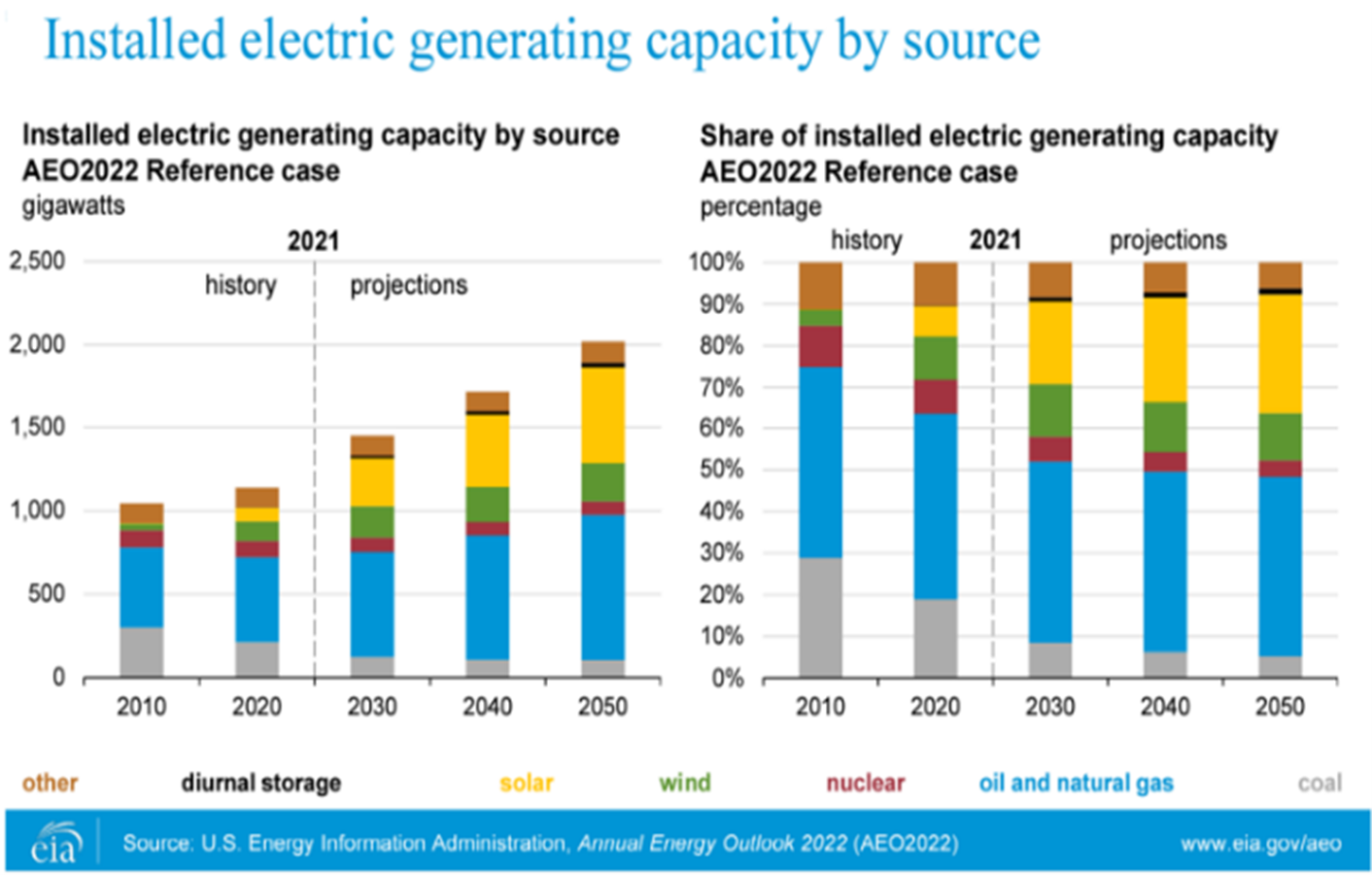 Source: U.S. EIA
Don Kane is a professional engineer with 34 years of experience in electric distribution planning and operations at a large, investor-owned utility. He specializes in system modeling, forecasting, reliability improvement, and general grid modernization. King is presently a senior engineer in the environment and energy group at Parsons Corporation.
In his view, “The proliferation of utility-scale wind and solar generation is already causing a big increase in transmission project work. Latest forecasts from U.S. Energy Information Administration (EIA) indicate solar and wind capacity to increase from around 250 GW to around 550 GW by 2030, and 800 GW by 2050. The Department of Energy (DOE) has a more aggressive forecast: 1,500 GW by 2035 and 2,500 GW by 2050 (along with a staggering 1,800 GW of energy storage). Even in a conservative outlook, it is obvious that electrical engineers will be faced with the challenges of integrating a huge amount of intermittent renewable generation over the coming years."
”New York takes the ‘charge’
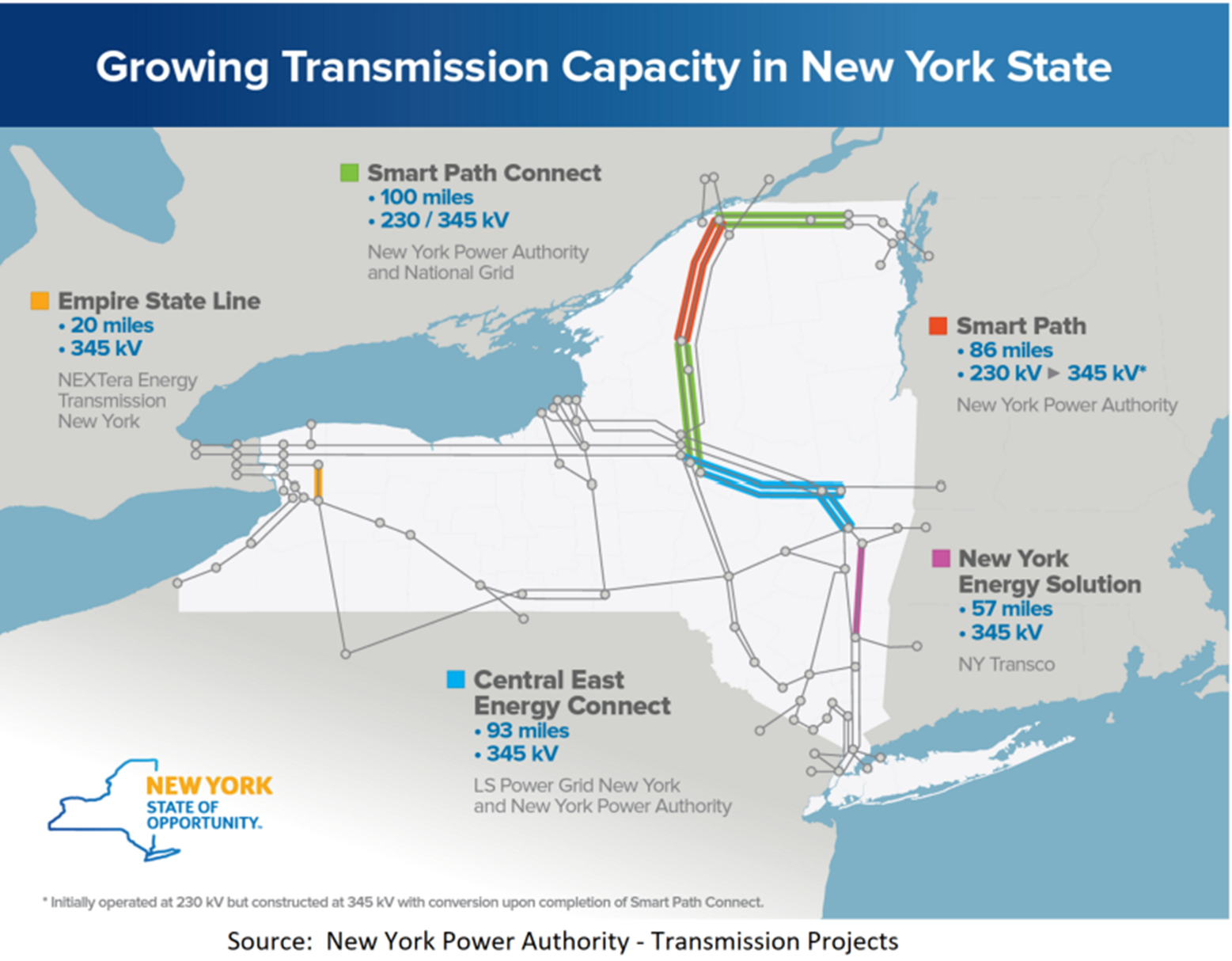
Some places are hoping to tackle these issues sooner than later. New York state, for example, conducted an expansive power grid study in 2020 in coordination with regulatory agencies and major electric utilities. This study identified $4.2 billion in near-term priority infrastructure projects, as well as longer term projects to facilitate renewables development. This does not include the state’s most notable in-progress investment: the $4.5 billion, 339-mile-long Champlain Hudson Power Express.
One of the challenges the state needed to address was serving electricity to the New York City and Long Island regions, which use two-thirds of the state’s power, but also pay high prices per kilowatt due to the lack of nearby generating plants. In addition, the city has a stated goal of being entirely powered by renewables sources by 2025.
 Source: New York Power Authority
The Champlain Hudson Power Express will deliver 1,500 MW to Astoria, Queens, via a transmission line installed in the sediments of Lake Champlain, the Champlain Canal, Hudson River and East River. Electricity will come from hydropower-rich eastern Quebec, Canada. Meanwhile, upgrades off Long Island will improve access to approximately 9,000 MW of offshore wind, slated for installation during the next 5-15 years. The state will also invest in a nation-leading 6 GW of energy storage by 2030; is currently building another 175-mile-long transmission line to connect wind turbines across its Southern Tier region; and added 421 MW of solar in April 2023 alone.
[See also: New York approves offshore wind farm transmission line]
All of these projects have seen investment from the New York State Energy Research and Development Authority and reflect a clear commitment, both in policy and investment, to administering BIL funds to meaningful renewables.
Many challenges remain
There are plenty of other headwinds for grand initiatives like this. Do not overlook the challenge of getting new transmission lines sited and built, especially when the proposed lines cross through regions that do not observe any direct benefit. The scope and the magnitude for grid investments in a renewable energy future cannot be understated, which, in some places, can create a political impasse.
Recent project cancellations like Northern Pass in New Hampshire and project delays, like the New England Clean Energy Connect in Maine, highlight the massive risk involved today for companies that pursue ambitious investments like this. Both projects would have delivered 24/7 dispatchable, renewable hydro power from Quebec into the New England grid, helping the states in the region achieve their own renewable energy targets. Local opposition to portions of the proposed lines were enough to prevent or delay the projects from proceeding, causing painful expense write-offs of a few hundred million dollars for the companies involved.
[Learn about the latest renewable energy technology developments with a free subscription to the Alternative & Renewable Energy newsletter from GlobalSpec]
Some proposals have looked at creating a more unified international electric grid, consisting of major generation networks in the U.S. and Quebec linked together in a single, high-voltage system. This would permit energy-rich areas to send electrical power to energy-poor areas. Not only will developers need to contend with ample not-in-my-backyard-ism, but the scale of the investments can also be a political and regulatory burden. High level estimates for a “macro-grid” like this exceed multiple trillions of dollars over a few decades. Daunting investments like this will require new ways of justifying and distributing costs across larger portions of the country, as well as changes to the traditional energy markets and regional operations of the grid, with much more coordination needed between the regional transmission organizations and independent system operators and across the separate interconnections.
Summary
Due to the ever-increasing demand and growth in popularity of such advances as electric vehicles, there is a growing list of challenges which power grid operators need to face. Both the flow and demand of electrons are changing – as renewable energy sources are added, the volume of intermittent electrons flowing in continues to increase, and as electromobility adoption grows, the demand will become more unpredictable. Threats proliferate, whether from cyber-attacks that continue to become more frequent and more sophisticated, terrorist attacks that remain unpredictable and difficult to prevent, or weather that grows more extreme and extracts a higher toll on aging power lines. And the shadow hovering over all – that none of these challenges are cheap, fast or easy to fix.
About the author
For more than four decades, Feller has worked to accelerate urban innovation at the intersection of sustainability, smart policy and private investment – all with a focus on economic development. Gordon has worked for leading organizations: World Bank, Ford Motor, Stanford, IBM, Apple, ISO, Chevron, Bechtel, Lockheed, the UN, national governments, Reuters and others. From 2010 to 2017 he served as director of urban innovation at Cisco Systems. Gordon founded Meeting of the Minds, a unique global leadership network to support innovation-powered cities. He was the Obama appointee on the matter. He sits on corporate and non-profit boards, and served as a Global Fellow at the Smithsonian Institution's Wilson Center in Washington, D.C.



As long as it is someone else's money, they're all for it.