
Efficient conductors for greener electricity grids
Engineering360 News Desk | December 29, 2021A new class of high-efficiency conductors for electricity grids will be built in a state-of-the-art manufacturing plant in the U.S. by California-based TS Conductor. The venture will proceed with financing from Breakthrough Energy Ventures, National Grid Partners, Talkot and Hervé Touati.
While the electricity generation segment of the energy industry has progressed to cleaner and more efficient solutions, the overhead conductor technology used by transmission and distribution grid operators has not materially changed since the emergence of aluminum core steel reinforced (ACSR) cables in 1908. ACSR still today represents over 95% of the utility cables deployed across the world.
According to Market Study Report, the global wires and cables market was estimated to represent $183 billion of sales in 2020, with an annual compounded growth rate anticipated to exceed 4% until 2028. Global investment in the power sector reached $780 billion in 2020 and was largely dominated by renewable power (48%) and electricity networks (32%) investments, according to the International Energy Agency (IEA). While considerable, the IEA notes that current levels of renewable energy and energy efficiency investments still fall short of what is needed to maintain global temperatures well below a 2º C rise.
The UN climate targets create the need for new cable technologies that can reduce electricity network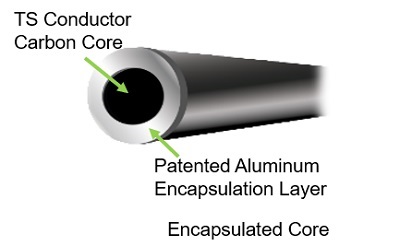 Source: TS Conductor losses and accelerate the connection of wind and solar farms, which is one of the major bottlenecks of renewable energy expansion. Network losses amount to approximately 2000 TWh annually, or 6.7 times the electricity consumption of the U.K.
“Transmission is fundamentally important to our climate mission, yet it has seen limited innovation over the years. It is rare to find a transmission technology like TS Conductor with as much potential in terms of deployability, cost and efficiency,” said Carmichael Roberts, Breakthrough Energy Ventures. “TS Conductor will be a major enabler of increasing electricity demand and increasing penetration of renewables in a critical time. We are delighted to lead this round with a stand-out team and an outstanding technology.”
The new conductors are based on a unique combination of carbon composite and aluminum encapsulation of the composite core. The conductors can be installed with the same tools and operating procedures as ACSR cables. And they are compatible with industry standard field practice and can be used for:
- Line reconductoring, allowing for the doubling of capacity of an existing line without having to change or retrofit any structures.
- Energy efficiency upgrades, reducing technical line losses by half without having to change or retrofit any structures.
- Insulation upgrades of distribution networks, reducing forest fire risks without having to change the poles or towers.
- Building new lines with lower structure costs or better characteristics (in capacity, efficiency, insulation).



This sounds like a variation on the ACCC type cables currently being sold and used by many utilities. They use a composite carbon core wrapped with lower tensile strength soft aluminum conductors in a typical compressed shape (instead of the round shape in ACSR cables. At the traditional operating temperatures they have somewhat greater current carrying capacity, significantly less sag, and lower weight. They can also be operated at much higher temperatures (up to 180°C instead of the 75°C for ACSR)--this allows the much greater current carrying capacity.
This article is just a press release for the funding of the company, and gives essentially NO information I would want to see. The biggest difference from ACCC appears to be the aluminum portion, pictured as if it is a solid tube instead of separate strands. More data would be worth reading.
--JMM