MIT study: Cut grid decarbonization costs with new transmission capacity
S. Himmelstein | January 19, 2021Expanding the U.S. transmission grid will play a key role in decarbonizing the country’s electricity system and a massive transmission build-out could also slash the costs of reaching zero-carbon grid with wind, solar and battery technologies that are currently cost-effective. A study conducted by MIT researchers suggests that federally coordinated interstate coordination and transmission system expansion could lower the cost of fully decarbonizing the electrical grid by 2040 by 46%, relative to an approach where states pursue individual goals.
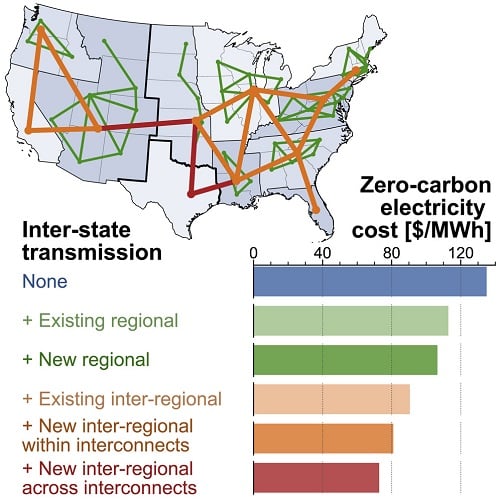 Streamlining the planning and permitting process for new transmission and coordinating decarbonization at the national level could enable a more efficient and rapid transition to a zero-carbon electricity system. Source: Patrick R. Brown et al.Greater decarbonization of the power sector can be realized with existing solar, wind, lithium-ion battery technologies. These renewable energy options were included in a planning and dispatch model of zero-carbon electricity systems for the continental U.S. along with seven years of hourly weather data from tens of thousands of available sites.
Reductions in the cost of photovoltaics, wind and lithium-ion batteries lead to the lowest electricity costs for systems in which transmission is expanded. Transmission improvements and expansions could include development of new high voltage DC lines, expansion of AC transmission links between balancing authorities and improved operating coordination. Nationwide transmission supports power-sharing across regions facing widely different weather systems that drive variation in wind and solar generation. This geographic diversity reduces the likelihood that renewables will not be able to meet demand and decreases the amount and duration of energy storage required to cover those gaps.
Interstate coordination and transmission expansion are projected to reduce the system cost of electricity in a 100% renewable U.S. power system by 46%, compared with a state-by-state approach, from $135/MWh to $73/MWh.
The research is published in Joule.