Renewables outpace coal in US power production
S. Himmelstein | April 19, 2023In 2022, electric power generated from wind, solar, hydro, biomass and geothermal sources surpassed coal-fired generation in the U.S. for the first time. Growth in wind and solar significantly drove the increase in renewable energy and contributed 14% of the electricity produced domestically in 2022.
Combined renewables, including wind, solar, hydro, biomass and geothermal, provided 21% of the 4.09 GWh of electric power produced last year in the U.S., compared to 19% in 2021, according to the U.S. Energy Information Administration (EIA) data. At the same time, coal-fired generation's share slipped from 23% in 2021 to 20% in 2022 as some coal-fired power plants retired and the remaining plants were used less.
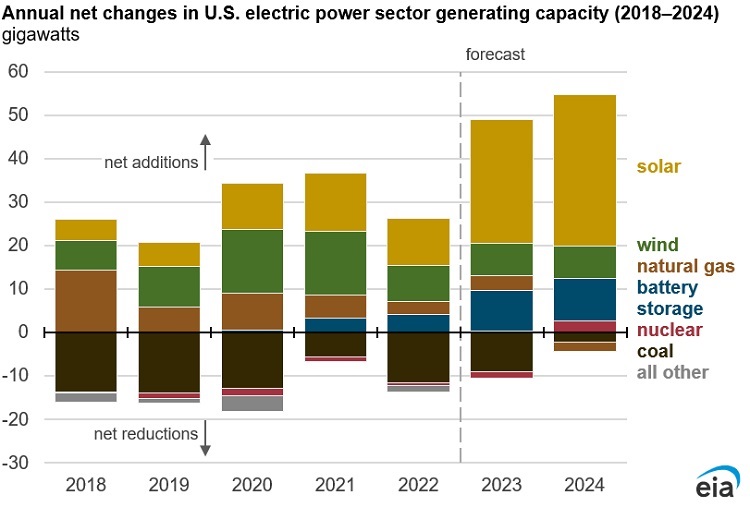 Source: EIA
Texas accounted for 26% of total wind generation capacity while California remains the solar energy sovereign, responsible for 26% of the national utility-scale solar electricity output in 2022.
The natural gas share of generation is forecast to remain unchanged from last year (39%); the coal share of generation is forecast to decline from 20% last year to 17% in 2023. Renewable generation also surpassed nuclear generation for the first time in 2021 and continued to provide more electricity than nuclear generation last year.
Forecasts indicate that solar, wind and battery technologies will account for most of the added capacity in 2023 and 2024. At the end of 2022, the electric power sector is estimated to have operated 72 GW of solar capacity, a share forecast to increase by 29 GW (40%) in 2023 and by 35 GW (35%) in 2024.