A sensor for predicting the freshness of foods
Marie Donlon | March 23, 2023A tiny pH sensor that determines when food has spoiled has been developed by researchers from Southern Methodist University.
The 2 mm in length by 10 mm wide sensor is reportedly small enough to be incorporated into food packaging like plastic wrap.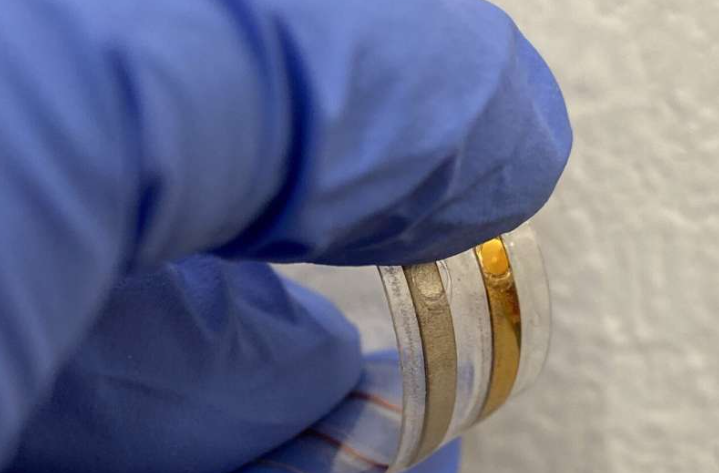 Source: Southern Methodist University
According to its developers, the sensor works like a wireless radio frequency identification device. Each time a package of food featuring this pH sensor passes through some pre-determined checkpoint — shipping logistics centers, harbors, gates or grocery store entrances, for instance — it would be scanned and the resulting data sent back to a server that monitors the packaging’s pH levels. This, according to the researchers, would enable continuous pH monitoring and the detection of freshness throughout the entire farm-to-table supply chain.
The researchers concentrated on pH levels due to the relationship between food freshness levels and this parameter. Food with a high pH level, where fungi and bacteria thrive, is an indicator of spoiled food. Consequently, sudden pH changes in food along any point of the production process — from storage to shipping — might suggest potential food spoilage.
To measure the pH level of a substance or a solution is to examine the concentration of hydrogen ions, which are electrically charged molecules, in that substance or solution. As such, the tiny pH sensor features electrodes that can detect the electrical charge produced by the hydrogen ion concentration in food and convert the level to pH values via the Nernst equation.
So far, the pH sensor has been tested successfully on fish, fruit, milk and honey, but the team aims to conduct additional testing.