An Incandescent Light Bulb as Efficient as an LED?
Engineering360 News Desk | January 25, 2016Researchers at the Massachusetts Institute of Technology (MIT) and Purdue University believe they have found a way to capture the heat emitted from incandescent bulbs and reflect it back to the filament to be re-absorbed and re-emitted as visible light. The approach would boost the lightbulb’s efficiency to that of fluorescent lights or even LEDs.
Incandescent bulbs heat a thin tungsten wire to temperatures of around 2,700 degrees Celsius. The hot wire emits what is known as black body radiation, a broad spectrum of light that provides a warm look and rendering of almost all colors in a scene.
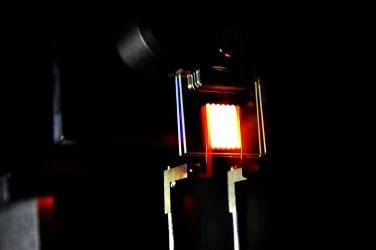 A proof-of-concept built by MIT researchers achieves efficiency comparable to some fluorescent and LED bulbs. Image credit: MIT.But these bulbs have always suffered from one major problem: more than 95 percent of the energy that goes into them is wasted, most of it as heat. The energy inefficient technology has been banned in many countries as a result.
To address the inefficiency issue, the MIT and Purdue team created a two-stage process, the first of which involves a conventional heated metal filament. In the second stage, instead of allowing the waste heat to dissipate in the form of infrared radiation, structures surrounding the filament capture the radiation and reflect it back to the filament to be re-absorbed and re-emitted as visible light. These structures, a form of photonic crystal, are made of Earth-abundant elements and can be made using conventional material-deposition technology.
That second step makes a difference in how efficiently the system converts electricity into light, researchers say. One quantity that characterizes a lighting source is the so-called luminous efficiency, which takes into account the response of the human eye. Whereas the luminous efficiency of conventional incandescent lights is 2-3 percent, that of fluorescents (including compact fluorescent lights, or CFLs) is 7-15 percent and that of most commercial LEDs is 5-20 percent. The new two-stage incandescents could reach efficiencies as high as 40 percent, the team says.
The team refers to their approach as “light recycling,” since their material takes in the unwanted wavelengths of energy and converts them into the visible light wavelengths that are desired.
Key to their apprach was designing a photonic crystal that works for a wide range of wavelengths and angles. The photonic crystal itself is made as a stack of thin layers deposited on a substrate. In their system, the desired visible wavelengths pass through the material and out of the bulb, but the infrared wavelengths are reflected as if from a mirror. The wavelengths then travel back to the filament, adding more heat that is converted to more light. The heat keeps bouncing back toward the filament until it ends up as visible light.
According to Marin Soljačić, professor of physics at MIT, the technology has potential for applications other than light bulbs. The same approach could have implications for the performance of energy-conversion schemes such as thermo-photovoltaics, in which heat from an external source makes a material glow, causing it to emit light that is converted into electricity by a photovoltaic absorber.
“LEDs are great things, and people should be buying them,” Soljačić says. “But understanding these basic properties”—about the way light, heat and matter interact and how the light’s energy can be more efficiently harnessed—“is very important to a wide variety of things.”