Wearable energy harvester inspired by zebras
S. Himmelstein | April 13, 2023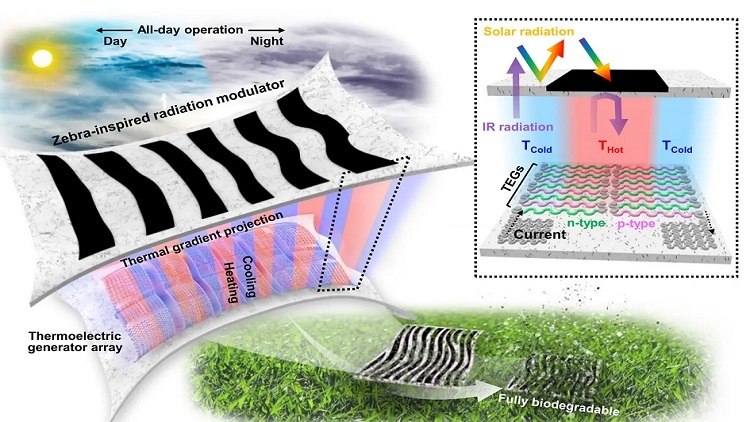 Schematic illustration of a biodegradable, stretchable energy-harvesting system. Source: Sci.Adv.adf5883
Why do zebras have stripes? Researchers have theorized that their purpose is to provide protection from biting flies or to camouflage the animals from predators. Thermoregulation has also been postulated as the function of this pattern: black stripes absorb heat in the morning to warm up zebras while white stripes reflect light and cool the beasts later in the day. This heat-regulating capability served as inspiration in the design of a device that produces electricity using contrasting shades as thermal conductors.
Researchers from Gwangju Institute of Science and Technology (China), Pusan National University (Korea) and Korea University engineered a bending and stretching fiber-type power generation system by applying the horizontal power generation mechanism inspired by the zebra pattern to biodegradable nanofilm material. The thermoelectric device generates electricity from the temperature difference caused by the black/white color difference on the surface of the film material.
The white stripes were formed with a biodegradable poly(l-lactide-co-ε-caprolactone) white fibrous membrane to reflect sunlight and emit infrared radiation, keeping the area below it cool. Black poly(3,4-ethylenedioxythiophene):poly(styrenesulfonate) provided the heat absorption required to create the temperature gradient underneath. With the aid of silicon nanomembranes in the design, the novel thermoelectric generator produced a 22° C (49.6° F) temperature difference for the gradient.
A prototype was demonstrated to convert this temperature difference into electric energy of up to about 6 μW/m2. The device described in Science Advances could be deployed to provide continuous power for flexible, wearable electronics, such as low-power sensors.