Self-Heating Battery May Boost EV Range
Engineering360 News Desk | January 22, 2016Engineers at Pennsylvania State University (PSU) have developed a lithium-ion battery that self-heats from subzero temperatures without requiring external warming devices or electrolyte additives. The innovation potentially will help increase cruise range for electric vehicles, robotics and space exploration applications that operate in cold environments.
Conventional batteries at below-freezing temperatures suffer power loss, which leads to slow charging in cold weather, restricted regenerative breaking and reduction of vehicle cruise range by as much as 40 percent, according to the PSU researchers, led by Chao-Yang Wang, professor of mechanical, chemical and materials engineering. These problems require larger and more expensive battery packs to compensate for the cold's sapping of energy.
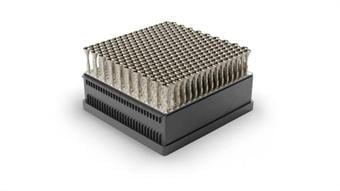
 The battery self-heats without the use of external warming devices or electrolyte additives. Image credit: Chao-Yang Wang/PSU. Wang and his colleagues developed an "all-climate battery" using a nickel foil of 50-micrometer thickness with one end attached to the negative terminal and the other extending outside the cell to create a third terminal. A temperature sensor attached to a switch causes electrons to flow through the nickel foil to complete the circuit. This heats the nickel foil through resistance heating and warms the inside of the battery. Once the battery is at 32 degrees Fahrenheit, the switch turns off and the electric current flows in a normal manner.
The researchers say that the internal warmup of such a cell to zero degrees Celsius occurs within 20 seconds at minus 20C and within 30 seconds at minus 30C, consuming 3.8 percent and 5.5 percent of cell capacity, respectively. The self-heated battery cell yields a discharge/regeneration power of 1,061/1,425 watts per kilogram at a 50 percent state of charge at minus 30C, delivering 6.4-12.3 times the power of state-of-the-art lithium-ion cells.