Drone Carries One Passenger and a Smartphone
Engineering360 News Desk | January 22, 2016EHang, a Chinese drone manufacturer, has developed an autonomous aerial vehicle (AAV) that provides personal transportation for short-to-medium distances, with potential applications in fields such as shipping and medical care. The ready-to-fly EHang 184 is a manned drone capable of carrying a single passenger who enters a destination into a smartphone app. Passengers require no pilot training.
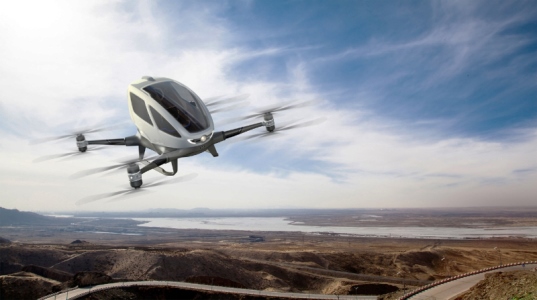 The vehicle uses multiple independent flight control systems to navigate passengers from point to point. Image credit: EHang.The vehicle uses multiple independent flight control systems to navigate passengers from point to point. The systems draw on real-time data collected from sensors throughout the flight to plot the fastest and safest route to carry passengers to their destinations.
The EHang 184 takes off and lands vertically, eliminating the need for runways. At 1.5 meters tall and with a weight of 200 kilograms, the AAV has a load capacity of 100 kilograms and a maximum output of 106W powered by eight motors. It is designed to carry a single passenger for 23 minutes at sea level, and at an average cruising speed of 100 km/h.
The vehicle body consists of a cabin with a gull-wing door, a trunk and a power system composed of four arms and eight propellers. The arms, when folded, allow the AAV to occupy the same sized parking space as a typical passenger car. Inside the cabin is a single seat whose design is similar to that in a Formula 1 racing car. In front of the seat is a tablet console through which passengers can input commands.
The communication system is fully encrypted, and each AAV comes with an independent key. In the event of an emergency, passengers can elect to halt flight and hover in the air. If the vehicle sustains damage in flight—for example, from a bird—the AAV's systems are designed to evaluate the damage and determine whether the craft must land to ensure passenger safety.