Fundamentals of liquid-liquid extraction
Seth Price | February 12, 2023Simply put, chemical engineering can be divided into two categories: putting things together and taking things apart. Reactors are used to combine chemicals together to make new things, and then various types of separators are used to remove contaminants or to remove the desirable product from an output stream. Separation processes are used to purify an output stream, divide the output stream into different products, or other such purposes.
Separation processes
There are many separation processes, such as distillation, crystallization, flotation, absorption, membrane processes, oxidation, stripping and others. The choice of separation process relies on the specific chemistry of the separation, the phases present and the economics of the equipment, operation and upkeep. When designing a new process or optimizing an existing process, chemical engineers must evaluate which separation process will be the most useful for a specific situation. This is often performed via chemical plant computer simulations, backed by hand calculations.
Liquid-liquid extraction
One separation technique used in industry is liquid-liquid extraction (LLE), sometimes called solvent extraction. LLE is particularly useful when one liquid must be separated from a solution, and their boiling temperatures are too close or unsuitable for distillation.
Perhaps the most common LLE operations are performed by extracting the solute from an aqueous solution and convincing it to go into an organic solvent. The aqueous solution and the organic solvent should be immiscible or only partially miscible. LLE will attempt to stir or otherwise disturb these two liquids, causing the solute to come into contact with the organic solvent. As it does, the solute will transfer to the organic solvent, as this will reduce the free energy. The enriched organic solvent, called the extract, can be removed, or the depleted aqueous solution, called the raffinate, can be removed, depending on which is most desirable. The process can be repeated as needed to continue purifying the chemical.
In a basic chemistry lab, LLE is often performed with separatory funnels. The two liquids are shaken manually to accelerate the contact between solute and organic solvent. Then, the mixture is allowed to settle, taking advantage of the fact that most aqueous solutions are more dense, and thus settle to the bottom. The aqueous solution is removed from the bottom of the funnel, and then the organic can be dumped out of the top. Depending on the circumstance, the extract or the raffinate can be fed back into the funnel multiple times to further purify the substance.
In industry, separatory funnels and manual shaking are not efficient. Instead, numerous extractor designs have been implemented. Some still use gravity as a means of separation after a mixing stage. Others use centrifugal forces to separate the two liquids. Another method yet involves pumping both solutions in counter-current fashion across a medium. One liquid spreads out on the surface of the medium, increasing the surface area, and thus speeding up the mass transfer.
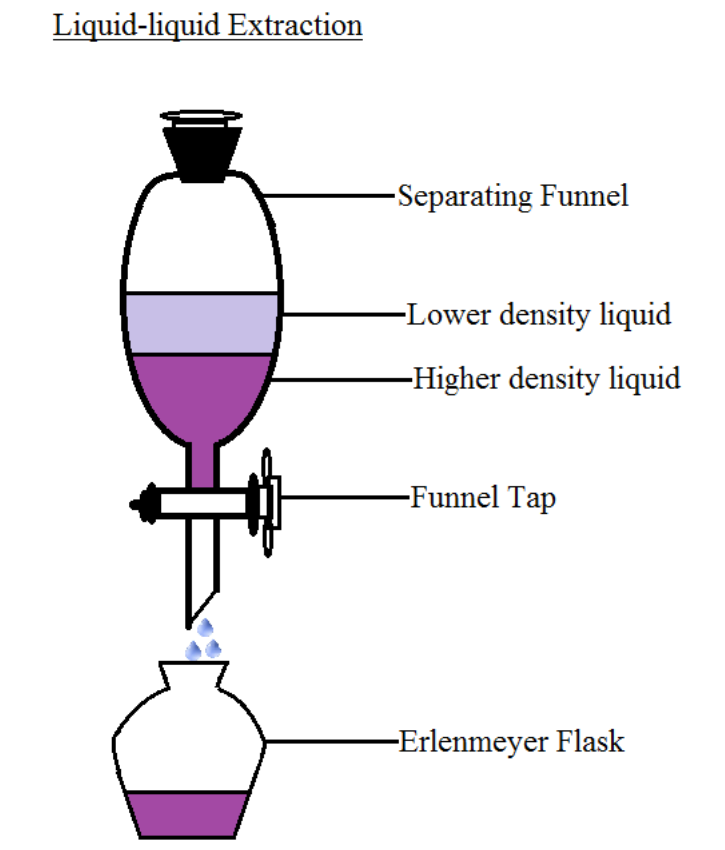 Source: Sjantoni/CC BY-SA 3.0
Controls
In industry, using continuous processes, LLE can be optimized by controlling the flow rates of the feed of the liquids as well as altering some of the means of placing these liquids in contact. For LLEs that have a mixer, the mixing speed and paddles can be altered, balancing energy consumption against purity. For extractors that have a contact medium (such as Berl saddles or Raschig rings), the medium can be replaced with different geometries and dimensions. Feed flow directions and determining whether one big stage or multiple small stages are also important design decisions, though they are difficult to alter once the system has been constructed. Temperature can also be a factor, as it changes the solubility limit of some substances.
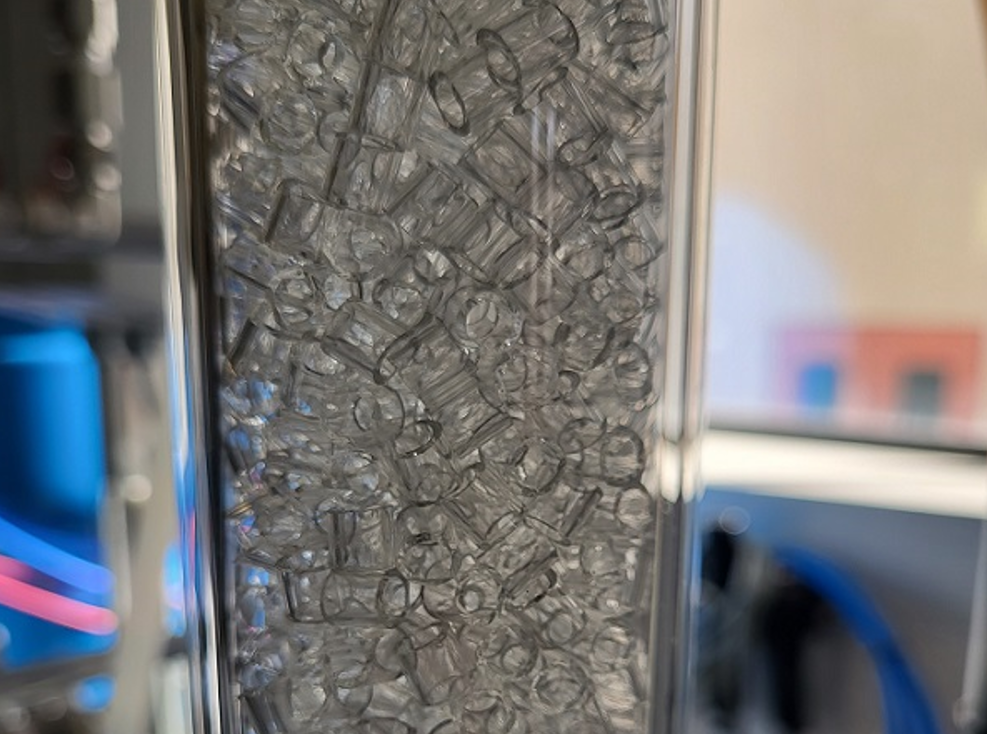 This pilot scale LLE column is packed with small Raschig rings, designed to increase the surface area. This particular column is designed to purify acetic acid, pulling it from aqueous solution into ethyl acetate. Source: Seth Price
One important step is to evaluate the purity of the final product, particularly when repeated extractions are occurring. Each step in LLE requires time, energy and solvent, and so optimizing the purity as weighed against the economics is essential to making this process viable. For example, it may be that the initial LLE step removes 60% of the solute, then the second removes another 40% from the remaining mixture, then the following step removes another 20%. At some point, there is diminishing financial returns, based on the sales price of the final product with relation to its purity.
Industrial examples
Many organic compounds are purified using the LLE process. In particular, vegetable oils, biodiesel, fruit juices, perfumes and other consumer goods can be processed in this manner. LLE can be used to remove impurities, such as pesticide residue from fruit juices, improving the safety and quality of the product.
A growing market for LLE is in the production of biodiesel. Biodiesel is an alternative often made from cooking oil or other fatty, organic wastes. While the process itself warrants its own article, one of the crucial steps is removing glycerine from the biodiesel, which is performed with LLE.
Another common use of LLE is to separate or purify certain metals in hydrometallurgical processes. Certain ores are leeched, or sprayed with acid, to remove the relevant metals. This metal-rich solution can be fed into an extractor, where the metal ions are transferred to the other liquid. From there, the extract can be dehydrated or processed in various methods to leave behind the desired metal. This process is used to purify uranium, plutonium and many rare Earth metals. It can also be used to separate nickel and cobalt, which have similar properties otherwise and are difficult to separate.
Final thoughts
LLE is a mature process, but there are still developments that improve the efficiency. As the world strives for cleaner, pure substances, either for health and environmental reasons or for the necessities of another process, there will continue to be a drive to optimize the LLE process. It will continue to impact food and beverage, chemical and petrochemical, pharmaceutical, metallurgical and water treatment industries.