
Chinese tokamak achieves Super I-mode
S. Himmelstein | February 07, 2023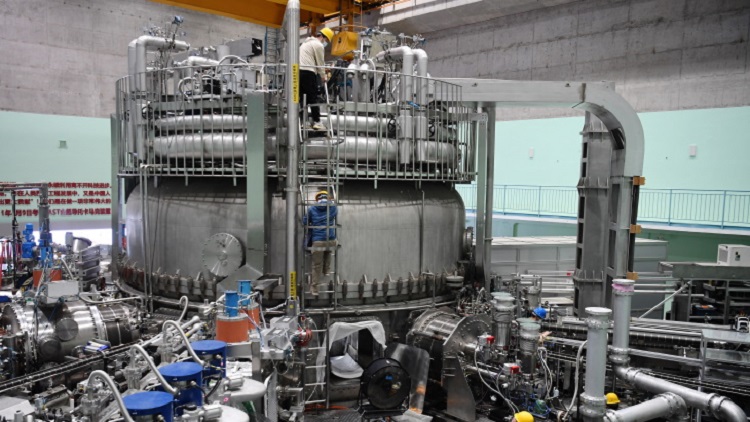 The EAST tokamak. Source: Hefei Institutes of Physical Science
A new mode of improved plasma confinement has been demonstrated at the Experimental Advanced Superconducting Tokamak (EAST) under development at the Hefei Institutes of Physical Science, Chinese Academy of Sciences.
The new high-confinement and self-organizing Super I-mode offers insights into how to better maintain the plasma operating stably and for long duration. Researchers noted that, compared with the I-mode initially observed on another fusion device, this new mode had even dramatically improved energy confinement, so it was labeled Super I-mode.
H-mode energy confinement is obtained without core impurity accumulation, resulting in reduced impurity radiation with a high-Z metal wall and ion cyclotron range of frequencies heating. I-mode has a stationary temperature pedestal with edge localized modes typically absent, while plasma density is controlled using divertor cryopumping.
In addition to improved energy confinement, the Super I-mode also has advantages over other scenarios, such as no metallic impurity central accumulation at the core, improved stability of the particle flux on the divertor and sustained quiet stationary plasma-wall interactions.
The discovery was made during a 2022 research campaign in which EAST achieved a stationary plasma with a world-record pulse length of 1,056 seconds.
EAST is the first fully superconducting tokamak with non-circular cross section and the first to incorporate superconducting toroidal and poloidal magnets. In operation since 2006, EAST offers a fully open test facility for world fusion community to conduct steady-state operation and International Thermonuclear Experimental Reactor-related physics research.
The research conducted by scientists from Chinese Academy of Sciences, MIT, General Atomics, Princeton Plasma Physics Laboratory and University of Science and Technology of China is published in Science Advances.



A stable plasma is great. Was there any indication of how close they were to having a thermonuclear reaction?