New gelatinous robot crawls in response to temperature changes
Marie Donlon | December 30, 2022A team or researchers from Johns Hopkins University has developed a gelatinous robot that crawls in response to temperature changes.
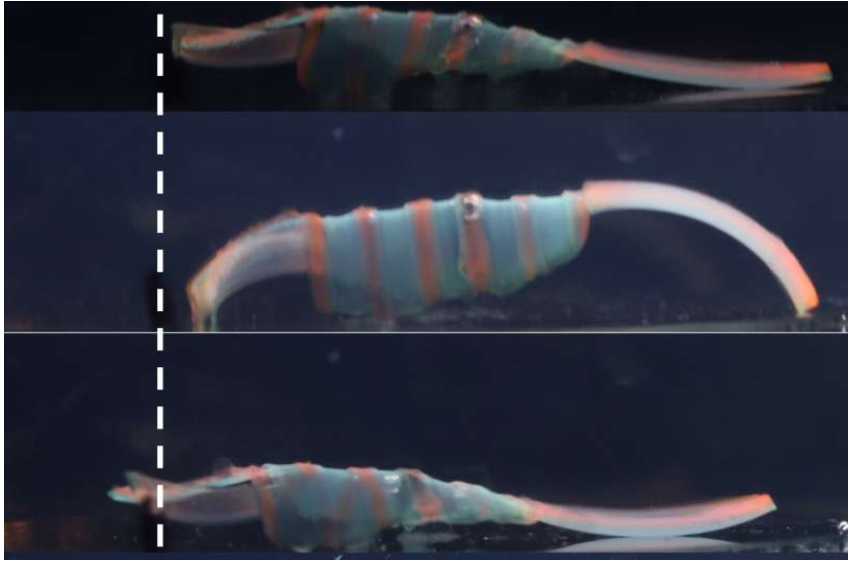
Inspired by the inchworm, the robot is able to move according to the swelling and shrinking of the gel — and in the absence of batteries, wiring and external power of any kind.
 Source: Aishwarya Pantula/Johns Hopkins University
"Our study shows how the manipulation of shape, dimensions and patterning of gels can tune morphology to embody a kind of intelligence for locomotion," explained the researchers.
During testing, the researchers demonstrated how the so-called gelbots could move forward and backward via swelling and shrinking of the gels in an undulating motion.
The researchers suggest that the gelbots could be used for applications such as targeted medicine delivery or as marine robots, patrolling and monitoring the ocean's surface.
The gelbots are detailed in the article, Untethered unidirectionally crawling gels driven by asymmetry in contact forces, which appears in the journal Science Robotics.
For more information on the gelbots, watch the accompanying video that appears courtesy of Johns Hopkins University.