The global status of nuclear power
S. Himmelstein | December 23, 2022Nuclear power has been experiencing a slow decline from a 17.5% peak share of global electricity generation in 1996 to a share of only 9.8% in 2021, as more countries put on hold or abandon their nuclear power strategies than are expanding them.
According to the World Nuclear Industry Status Report 2022, global nuclear power generation rose by 3.9% in 2021, the same rate by which it had dropped in 2020. In 2022, 411 reactors were operational around the world — 26 fewer than in 2011. Another 29 are currently in long-term storage and 53 are under construction; more than half of these are in China and India.
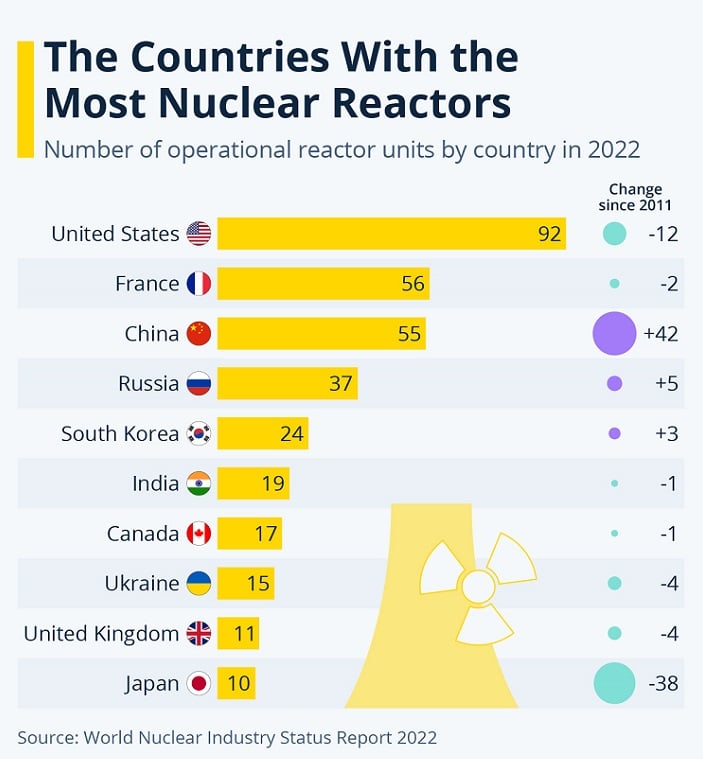 Source: World Nuclear Industry Status Report 2022
Of the 33 countries currently operating nuclear power reactors, only 15 are listed as still actively pursuing the technology, including 2020 nuclear energy newcomers Belarus and the United Arab Emirates.
The world's fastest growing nuclear energy program is also one of the youngest: China has used nuclear energy since the early 1990s and currently operates 55 nuclear reactors, the majority of which joined the grid in just the past decade. The U.S. remains the world's biggest nuclear energy stronghold, with 92 operational reactor units as of July 2022, down 12 since 2011. Despite the decline, the U.S. program is listed as active, as is the Japanese one, which saw a massive loss of 38 units since 2011. At currently 10 active nuclear reactors, it is expected that Japan will soon officially abandon new nuclear energy construction.
[Discover more about nuclear power technology on GlobalSpec.com]
Only three countries that had nuclear energy programs have so far shut off all reactors: Italy in 1987, Kazakhstan in 1998 and Lithuania in 2009. Germany has extended its program during the current energy crisis but plans to end nuclear energy production in 2023.
 Source: World Nuclear Industry Status Report 2022
The average age (from grid connection) of operating nuclear power plants has been increasing since 1984, and as of mid-2022 is 31 years, up from 30.9 years in mid-2021. A total of 270 reactors, two-thirds of the world’s operating fleet, have operated for 31 or more years, including 105 — more than one in five — for at least 41 years
The average age of reactors in the U.S. passed 40 years in 2020 and reached 41.2 years as of the end of 2021. France’s fleet now exceeds 36 years. Russia inverted the curve starting in 2016 and its average fleet age of 28.4 years as of the end of 2021 remains 1.8 years below the 2015-peak. South Korea’s reactors at 22.4 years remain almost half as old as the U.S. fleet, and China is the obvious newcomer with an average fleet age of just 8.8 years.