
Duke Energy will seek license extensions for 11 nuclear reactors
David Wagman | September 24, 2019Duke Energy said it will seek to renew the operating licenses of the 11 reactors it operates at six nuclear stations in the Carolinas for an additional 20 years.
The utility's first nuclear power plants will approach the end of their current operating licenses in the early 2030s. The company said it expects to submit the license renewal application for Oconee Nuclear Station in 2021, followed by its other nuclear stations. Oconee is the company’s largest nuclear station, with three generating units that produce more than 2,500 megawatts (MW).
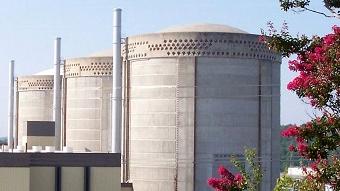 The three-unit Oconee nuclear station. Source: Duke EnergyThe combined generating capability of these facilities is roughly 10,719 MW.
U.S. nuclear facilities are licensed by the U.S. Nuclear Regulatory Commission and were originally licensed to operate for 40 years. Regulations allow nuclear licensees to renew their licenses for up to 20 years at a time.
As of Jan. 1, 2019, 98 nuclear reactors were operating at 60 nuclear power plants in 30 states. Thirty-six of the plants have two or more reactors. The Energy Department said that nuclear power has supplied about one-fifth of total annual U.S. electricity since 1990.
Roughly 31 countries had commercial nuclear power plants, as of 2016, the Energy Department said. In 15 of the countries, nuclear energy supplied at least 20% of their total annual electricity generation. The United States had the largest nuclear electricity generation capacity and generated more nuclear electricity than any other country. France had the second-largest nuclear electricity generation capacity and second-highest nuclear electricity generation. It also had the largest share — about 73% — of total annual electricity generation from nuclear energy.
Duke units
All Duke Energy-operated nuclear units have received one renewed license for an additional 20 years. The process to renew licenses for a second 20 years requires a years-long analysis and evaluation to determine the units can safely operate for the extended operation period.
The nuclear reactors that Duke intends to relicense include the following:
The two-unit Brunswick Nuclear Plant in Southport, North Carolina. This was the first nuclear power plant built in North Carolina. Unit 2 began commercial operation in 1975 and Unit 1 in 1977. Brunswick Nuclear Plant has a total generating capacity of 1,870 MW.
Catawba Nuclear Station is in York County, South Carolina. Catawba Nuclear Station is jointly owned by North Carolina Municipal Power Agency Number One, North Carolina Electric Membership Corporation, Piedmont Municipal Power Agency and Duke Energy. Unit 1 began commercial operation in 1985, followed by Unit 2 in 1986. Combined, the two units have a generating capacity of 2,310 MW.
The single unit Harris Nuclear Plant is roughly 22 miles southwest of Raleigh, North Carolina. It has a total generating capacity of 928 MW and began commercial operation in 1987.
McGuire Nuclear Station is in Mecklenburg County, North Carolina. Unit 1 began commercial operation in 1981, followed by Unit 2 in 1984. The station has a total generating capacity of 2,316 MW.
Oconee Nuclear Station is in Oconee County, South Carolina. Unit 1 began commercial operation in 1973, followed by Units 2 and 3 in 1974. The station has a combined generating capacity of 2,554 MW.
The single-unit Robinson Nuclear Plant is near Hartsville, South Carolina. It began commercial operation in 1971 and has a generating capacity of 741 MW.
Duke's McGuire, Oconee, Catawba, Robinson and Harris nuclear plants are pressurized reactor designs. Brunswick is a boiling water reactor design.
Pressurized water reactors keep water under pressure so that it heats, but does not boil. This heated water is circulated through tubes in steam generators. Water inside the steam generators circulates around these tubes and is heated into steam, which then turns the turbine generator. Water from the reactor and water that is turned into steam are in separate systems and do not mix.
Boiling water reactors allow water in the reactor vessel to boil into steam to spin a turbine generator. A closed condenser water system cools this steam back into water so it can be pumped back to the reactor vessel. The nuclear fuel core is cooled in the process.



The first question to be asked is where are they going to put the waste materials.
ALL of our storage facilities are overflowing and are very dangerous. An article a couple of days ago expressed concern for a spontaneous nuclear explosion. It is time to move to thorium and give up the nuclear weapons.