Solar Cell Using Lead from Recycled Car Batteries
By Engineering360 News Desk | January 10, 2016Engineers at the Massachusetts Institute of Technology have developed a procedure for making a type of solar cell using lead recovered from discarded car batteries.
Today, old car batteries are recycled, with most of the lead used to produce new batteries. But battery technology is changing, and the 250 million lead-acid batteries in U.S. cars today may become waste.
“If we could recover the lead in those batteries and use it to make perovskite solar cells, it’d be a win-win situation,” says Angela Belcher, professor of biological and materials science and engineering.
To test her theory, Belcher and Paula Hammond, professor of chemical engineering, scraped lead material from the electrodes of a used car battery and then synthesized lead iodide powder. They then dissolved the powder in a solvent and dropped it onto a spinning disk made of a transparent conducting material, where it spread out to form a thin film of perovskite. After performing several processing steps, they integrated the perovskite film into a functional solar cell that then converted sunlight into electricity.
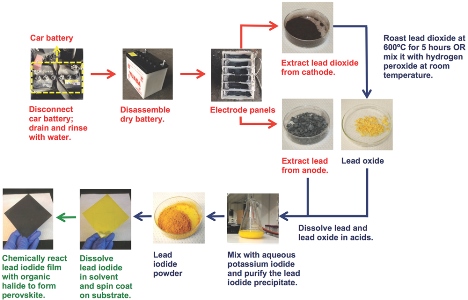 Synthesizing lead iodide perovskite from a recycled car battery. Image credit: MIT.The procedure for recovering and processing the lead could easily be scaled up and commercialized, they say. But Belcher and Hammond knew that manufacturers would have a question: if solar cells made from recycled materials are inferior to those made from lead iodide purchased from a chemical company?
To answer that question, they made solar cells using commercially available materials to compare against the performance of those made from recycled lead. They then evaluated the light-harvesting capability of the perovskite thin films made from the car battery against that of the films made from high-purity commercial lead iodide. In a variety of tests, the films displayed the same nanocrystalline structure and identical light-absorption capability. Moreover, the films’ ability to absorb light at different wavelengths was the same.
They then tested solar cells they had fabricated from the two types of perovskite and found that their photovoltaic performance was similar. One measure they tested was power conversion efficiency, which is the fraction of the incoming solar power that comes out as electrical power. The performance of the two types of solar cells was found to be almost identical, they say.
Initial results were based on solar cells made from a single discarded car battery. Might the outcome be different using a different battery? For example, the researchers were able to recover more than 95% of the usable lead in the battery they initially sourced. Would that fraction be lower in an older battery? And might the quality or purity of the recovered lead differ?
To find out, the researchers bought three more batteries that had been operating for six months, two years and four years, respectively They then followed the same procedures to recover and synthesize the lead iodide and fabricate solar cells. The outcome was the same, with one exception: in the older batteries, some of the lead occurs in the form of lead sulfate—a result of reactions with the sulfuric acid electrolyte. But they found that their original procedures were effective in recovering the lead from the lead sulfate as well as from the other compounds inside the batteries.
Based on their results, Belcher and Hammond say that recycled lead can be integrated into any type of process that researchers are using to fabricate perovskite-based solar cells, or to manufacture other types of lead-containing solar cells, light-emitting diodes and piezoelectric devices.