System Enables Early Detection of Storm Sewer Overflow
Engineering360 News Desk | January 06, 2016Fujitsu Laboratories has succeeded in tests of a low-cost system to detect early signs of storm sewer overflows during torrential downpours. It says the system can be used to help mitigate the damage inflicted on communities from such events.
A field trial in the city of Koriyama tested two functions of the sewer-monitoring system: (1) the effectiveness of an energy-harvesting technology that converts small amounts of energy from the natural environment into electricity, and (2) the ability of a sensor system powered by this energy to monitor water levels in real time using a cloud-based system.
To verify the effectiveness of energy-harvesting technology to convert small amounts of energy from the natural environment into electricity, Fujitsu engineers developed what they say is a highly efficient thermoelectric generator module that uses thermal storage material to convert temperature differences into energy.
The results confirmed that the modules generated at least five times as much electricity as conventional thermoelectric generators. In simulation trials, a sufficient amount of electricity was obtained to enable operation for five years or more, during which time it would not be necessary to replace batteries.
To test the system's ability to detect early signs of storm sewer overflows, engineers monitored the wireless transmission of storm sewer water-level data from sensors inside manholes. They detected early signs of sewer overflows in the form of a sudden rise in water level of 2.2 meters in 20 minutes during a torrential downpour.
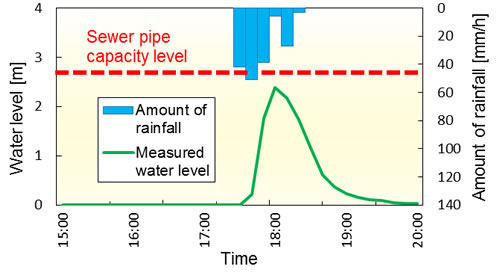 Amount of rainfall and change in water levels during a torrential downpour. Image credit: Fujitsu.According to Fujitsu, by quantifying changes in water levels, it is possible to verify storm sewer drainage plans, which can be put to use in formulating countermeasures to prevent flooding. In addition to potentially reducing operating costs of storm sewer monitoring, the company says that, because the energy-harvesting technology eliminates the need for frequent replacement of batteries, the risks associated with maintenance work on manholes located in high-traffic areas are reduced.
Based on the results of its tests, Fujitsu says it plans to commercialize the technology sometime in 2016.