All about crystalline silicon solar cells
N. Mughees | October 25, 2022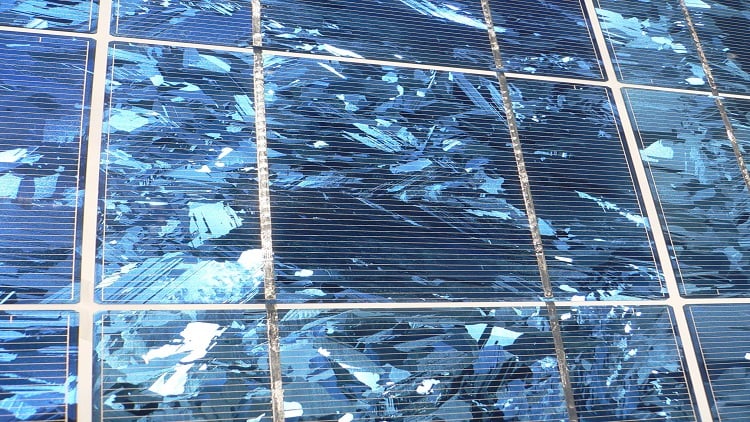 Solar cells composed of polycrystalline silicon. Source: George Slickers/CC BY-SA 3.0
As the primary natural energy source, sunlight satisfies the energy requirements of people around the world. Even though solar energy is variable, it offers energy security, better reliability, independence and contributes indirectly to global warming reduction. This energy form has been harnessed throughout the ages by use of ever-evolving technologies. Two primary solar cell types, thin-film and wafer-based, have been the focus of major advancements. Crystalline silicon (c-Si) is the predominant material in wafer-based solar cells, while amorphous silicon is an essential component of thin-film cells.
The electronic performance of c-Si wafers has improved to such a degree that advancements in solar cells are now primarily dependent on improvements in contacting systems and surface passivation. Passivation is utilized to prevent the recombination of generated carriers on the Si surface. Dielectric materials like silicon nitride and aluminum oxide are usually used to passivate surfaces; silicon carbide and silicon oxide are also used.
Structure of c-Si wafers
Monocrystalline and polycrystalline Si are the two distinct types of c-Si solar cells. The monocrystalline structure is homogeneous and consists of a single, continuous crystal with no grain boundaries. Throughout the material, the alignment of Si atoms and the lattice parameter remain constant. Polycrystalline Si, on the other hand, consists of numerous tiny Si crystals. In both polycrystalline and monocrystalline forms, the Si atom is covalently bonded to four adjacent atoms via tetrahedral bonds. This tetrahedral structure forms a crystal lattice that is perfect and well-defined.
Efficiency of c-Si wafers
Polycrystalline Si blocks are typically manufactured through the casting method. Si feedstock is initially melted, then poured into molds and finally solidified into blocks. Even though polycrystalline silicon wafers are less expensive than monocrystalline, they include numerous impurities and crystal defects, making it more fragile. Nonetheless, the improvement in material quality, especially during cell processing or crystallization, has enabled efficiency improvements of as high as 22% to 26%.
Absorption efficiency of c-Si wafers
The capacity of a solar cell to absorb light is also a significant characteristic. Regarding the absorption coefficient, amorphous Si (thin-film based solar cells) possesses significant benefits. This material absorbs photons with energies greater than 1.8 eV with an order of magnitude higher absorption coefficient than c-Si. Here, structure plays an important role. The well-defined crystalline structure of the wafer entails well-defined bond angles and bond lengths, which represent internal homogeneities. Therefore, the impact of internal light scattering is negligible. In contrast, the amorphous or non-crystalline construction of amorphous Si is characterized by bond angles and bond lengths that are perturbed, representing internal inhomogeneities. Such internal irregularities play a part in internal light scattering. Consequently, amorphous Si-based solar cells efficiently capture light.
A high absorption coefficient actually is beneficial in two ways. First, assuming the same amount of light absorption, amorphous Si has a lower material demand, which further means lower thickness of solar cells when compared with c-Si wafer-based solar cells. It is generally seen that 100 times less material is required to capture sunlight. Also, when the light conditions are dim and diffused, a higher absorption coefficient leads to good light absorption. Hence, thin-film solar cells are considered to be better than ci-Si wafer solar cells for indoor use.
Electrical stability of c-Si wafers
Electrical stability is yet another significant factor. C-Si wafers have good electrical stability without the challenges encountered when using thin-film solar cells. The hydrogenated nature of amorphous Si incurs a price: unique to such solar cells is a kind of light-induced degradation process called as the Staebler-Wronski Effect. For example, in just the initial 100 hours of contact with light, the efficiency of amorphous Si solar cells may decrease by 10% to 15%, as evaluated by a reduction in dark conductivity and photoconductivity.
(Find information on photovoltaic technologies and solar cell manufacturers on GlobalSpec.com.)
Temperature stability of c-Si wafers
With exposure to direct sunlight, heat absorption is inevitable. In many instances, the temperature of a solar cell under direct sunlight can reach approximately 70° C. Generally, the power generated by c-Si solar cells falls by 0.4% to 0.5% and amorphous solar cells fall by 0.2% to 0.25%, for every 1° C rise in temperature. In general, amorphous cells are less affected by temperature than their c-Si counterparts.
Conclusion
In a nutshell, the structural difference of Si is significant for solar cell usage. Regardless of the low stability and efficiency issues of amorphous Si solar cells, they benefit from a standardized and straightforward production method. Nevertheless, c-Si wafer based solar cells are gaining ground due to their lower price. It is difficult to determine which technology is dominant. Rather, each possesses an irreplaceable individuality. Generally, c-Si solar cells are suitable for use when the installation space is constrained. Due to their advanced conversion efficiency, the area needed to generate 1 kW of power is half that of thin-film solar cells.