A refresher on heat transfer methods
Seth Price | September 06, 2022One of the major energy expenses in industry is either generating or dealing with heat. Sometimes, heat is desirable, as it melts the scrap steel in the arc furnace or speeds up the reaction in a chemical plant. Other times, it is a nuisance that must be handled, such as excess heat from electronics or exothermic chemical reactions.
In general, anything that is hotter than it needs to be is generating waste heat that needs cooling, and anything that benefits from additional heat should get it. In an ideal world, waste heat would magically transfer to the places where additional heat is needed, but in reality, the heat transfer is a little more complicated.
To make a process cost-effective, proper heat management is essential. Before delving into optimizing heat management, it is important to review some of the basics of heat transfer and a few commonly used methods of industrial heating.
Heat transfer methods
From introductory physics class, most engineers learned that there are three methods of heat transfer: conduction, convection, and radiation. Every heating process will involve all three of these on some level, though the specific operating conditions will dictate the most dominant mode in a given situation.
Conduction
Conduction transfers heat through physical, direct contact. Energy flows from the hot object to the cooler object. Every unfortunate child who has touched a hot stove has inadvertently learned about conductive heat transfer.
Conductive heat transfer is governed by several properties. Besides the obvious quantities, such as the temperature of both pieces in contact and the size of each piece, the thermal conductivity of both materials will dictate how much heat is transferred and how it is distributed.
On a stove top, the thermal conductivity of the burner is high, and so heat transfers through it evenly (for the most part), and will readily transfer to the pan, or the young engineer’s fingers. However, the thermal conductivity of the skin is relatively low, meaning the pain is felt near the contact point on the fingertips.
Also, consider an electrical technician soldering parts onto a circuit board. The technician holds the solder at one end while it is being melted a short distance away at the other end. This is because the thermal conductivity of the solder is low.
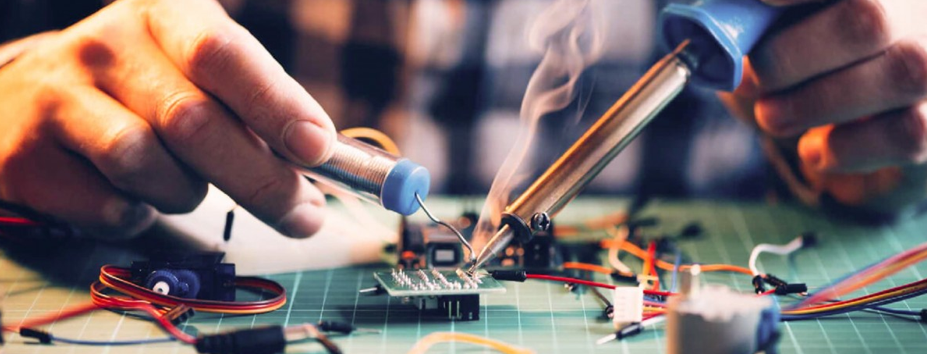 The solder, often a lead-tin alloy, has very poor heat transfer capabilities. While this helps the technician during soldering, it does not do a good job of transferring heat away from a microchip
For non-steady state processes, the heat capacity of both materials is relevant. Consider soldering as an example again. If the technician drips solder onto a hard plastic tray nearby, the solder may not damage the tray. Even though the solder is at a high enough temperature to melt the tray, the drop is small and the heat capacity of the solder is low. This means it can only contain a small amount of energy, which transfers to the plastic tray, but does not raise its temperature enough to melt it, as the plastic tray has a higher heat capacity.
Convection
Convection is an efficient heating mechanism that can transfer heat quickly, provided there is a medium that is free to circulate around the object. In order for convection to occur, the object must be in a fluid, either a liquid or a gas, such as water or air.
The mechanism for convective heat transfer relies on the density differences in the fluid. As the fluid is exposed to the higher temperature of a heated object, the fluid heats and becomes less dense. Because it is less dense, it moves upward, away from the surface, and cooler fluid fills the void, and the process continues.
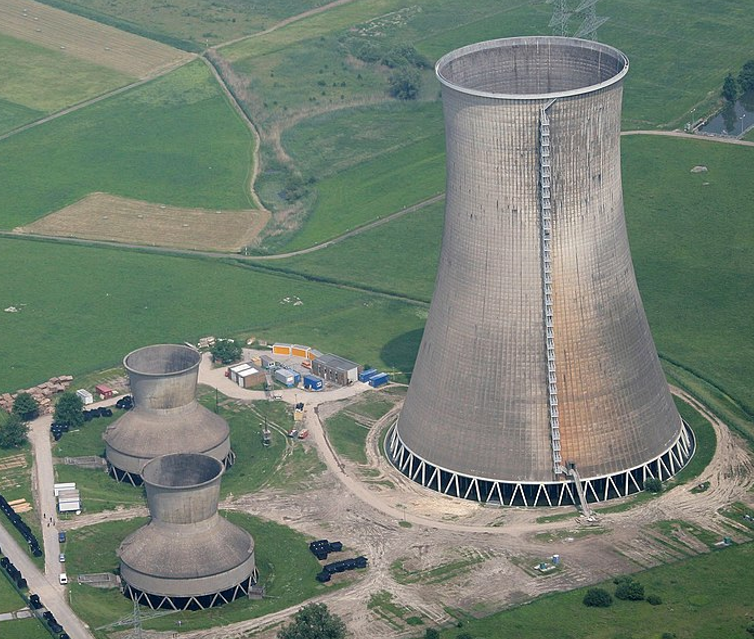 Cooling towers, like this one, use convection to remove waste heat from a process fluid. They are often associated with nuclear power plants, but this design is more efficient than previous designs, so other power plants and industries have adopted this style. Source: Tim Reckmann/CC BY-SA 3.0
There are two subcategories of convection: natural and forced. Natural convection occurs without any additional help; think of pies cooling on the table, where the pie cools simply because it heats the air around it, and the warmer air circulates away. Forced convection is where a fan speeds up the air flow, or a pump circulates the coolant around an object. Forced convection is faster than natural convection.
Convective heat transfer largely depends on temperature difference between the object and the fluid, the exposed surface area between the two, and an empirically derived heat transfer coefficient. The larger the surface area, the stronger the heat transfer, which is why heat sinks with cooling fins work better than those without.
As a side note, virtually all weather phenomena are based on convection, where the sun heats the surface, causing air near the surface to rise due to density differences. The rising air eventually forms clouds.
Radiation
Radiation is a broad term encompassing several different methods of heat transfer. In physics, radiative heat transfer refers to “blackbody” radiation, where any object that has a temperature above 0 K is emitting some heat. In order for radiative heating to be significant, the temperature must be high, as radiative heat transfer increases by the fourth power of the temperature, according to the Stefan-Botzmann Law. Typically, other heat transfer methods dominate over blackbody radiation.
Radiative heat transfer can also refer to using an energy source, such as microwaves, to cause the molecular bonds of a substance to vibrate faster. Because temperature is a measure of how fast the bonds are vibrating, bombarding a substance with energy that causes their bonds to vibrate faster will cause the temperature to heat. This is what happens in a microwave oven; the microwaves cause the water molecules to vibrate faster, heating up dinner. However, in order for this to work, the vibrations must occur at the resonant frequency of the bonds, otherwise the energy transfer is not efficient.
As far as industrial processes, radiation is often a minor player in industrial heating. If substances are heated under vacuum, such as some super-alloys, radiative heat transfer is important, because there is no fluid to allow for convective heat transfer. Radiative heat transfer to materials via microwaves is only possible for certain substances, as the resonant frequency of their chemical bonds must be known and the electromagnetic wave magnetron tuned for that particular frequency for this to be efficient.
The sun transfers all its energy to Earth via radiative heat transfer. Thankfully, the sun neither touches Earth (no conduction), and through the vacuum of space, it cannot convectively transfer energy. Because the sun is so hot, radiative heat transfer is the dominant method.
The next steps
Most industrial examples rely on multiple heating methods to function. For example, consider a steam-heated chemical reactor. First, some substance is burned, releasing energy by breaking chemical bonds and heating the air through convection. The convection is then used to heat water in the boiler, which heats efficiently due to convection currents in the water, eventually converting it to steam. The steam may be fed through a heating jacket, which may directly heat the reactor via conduction through the steam pipes touching the heating jacket. From there, convection currents inside the chemical mixture provide the even and efficient heating required.