Low-cost technique assesses 3D-printed metal component quality
S. Himmelstein | April 12, 2022Detecting defects in 3D-printed metal parts for use in aircraft or other critical systems is a time- and cost-intensive process involving scanning electron microscopy (SEM). A faster, lower cost measurement method based on directional reflectance microscopy has been developed at Nanyang Technological University, Singapore.
Recognizing that 3D-printed metal alloy objects are composed of a lattice of microscopic crystals,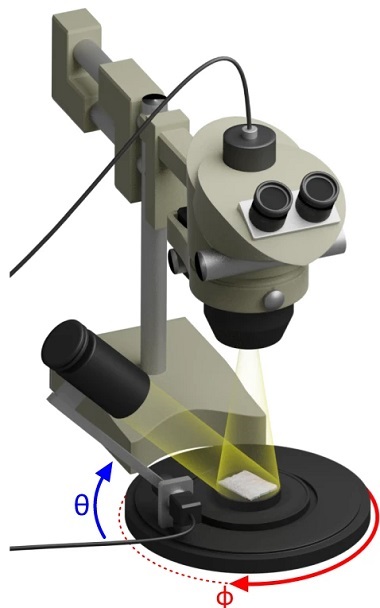 Schematic representation of the directional reflectance microscope. Source: M. Wittwer and M. Seita/Nanyang Technological University researchers sought a method to quickly and accurately map crystal size and orientation to help infer strength, structural flaws and other material properties. The new directional reflectance microscopy approach provides the same quality of information as SEM in a matter of minutes using an optical camera, a flashlight and a notebook computer that runs proprietary machine-learning software.
The metal surface is first treated with chemicals to reveal the microstructure, after which multiple optical images are taken with the camera as the flashlight illuminates the sample from different directions. The software analyzes the patterns produced by light reflected off the surface of different metal crystals and deduces their orientation in a process that takes about 15 minutes to complete.
The measurement method was successfully demonstrated with 3D-printed samples of Inconel 718, an alloy used for many components in aircraft, rocket engines, turbines and combustion chambers. The measurement method described in npj Computational Materials is expected to be of value in the certification and quality assessment of metal alloy parts produced by 3D printing.