Structural flaw uncovered in lithium batteries
S. Himmelstein | May 04, 2026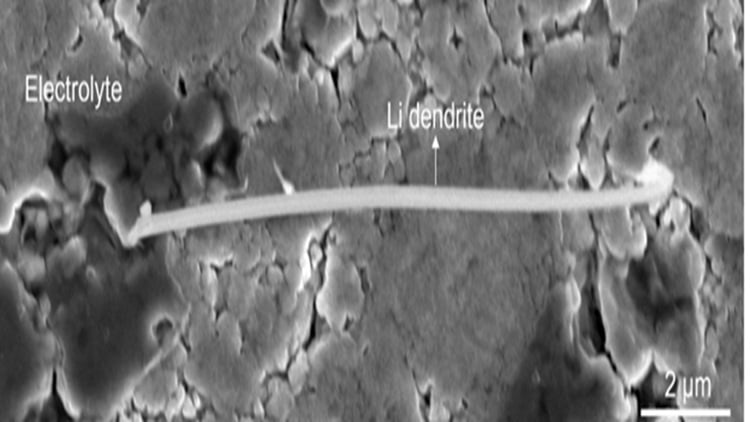 Lithium dendrite growth from solid electrolyte. Source: 10.1126/science.adu9988
Lithium dendrite formation undermines lithium-metal batteries performance and can result in damage and safety hazards including short circuits and fires. Long-thought to be soft and ductile, recent research demonstrates that lithium dendrites are not just strong but, crucially, brittle. This discovery could have profound implications for the design, safety and longevity of next-generation batteries that power modern electronics and electric vehicles.
The malleability of lithium has previously led engineers to conclude that solid-state electrolytes — ionic conductors that replace the flammable liquid electrolytes — would be sufficient to inhibit dendrite penetration simply due to their physical barriers. However, a study published in Science has upended this notion through operando scanning electron microscopy (SEM) imaging techniques that captured, for the first time, live video footage of lithium dendrites snapping inside functioning batteries.
Researchers from the Georgia Institute of Technology, Rice University, University of Houston and Nanyang Technological University (Singapore) determined that the stiffness of the dendrites is intrinsic to their nanoscale single-crystal lithium core and further reinforced by a protective surface coating, a combination that enables them to pierce separators.
“For decades, the scientific community assumed that solid-state electrolytes could easily block dendrites because lithium was thought to be a soft, ductile metal. We have proven they are actually brittle and snap like glass,” said the researchers.
The exploration of lithium alloy anodes capable of resisting or mitigating brittle fracture is advocated. Alloying could alter the mechanical properties of the electrode, potentially making dendrites less likely to snap and penetrate separator layers.